
Frack waste is evidently a lot “hotter” than the regulators have been telling us. The most common methodology of testing frack flowback for radioactivity understates the level of radiation by over 90%. Which may account for the low standards in Fracksylvania for spreading fracking flowback on roads: “It’s OK to use flowback as de-icer as long as it doesn’t glow.” That might give it away.
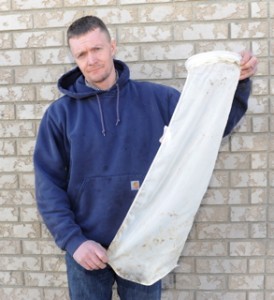
The frackers take the radioactive frack water filters, known as “frack rubbers,” which become highly radioactive, and dump them wherever they can. Like abandoned filling stations. Open trailers. Trout streams. Idaho. Places like that. 150 such illegal dumps have been found in North Dakota. They keep turning up anywhere the frackers can hide them.
http://cen.acs.org/articles/
Analytical Test Could Underestimate Radioactivity In Fracking Wastewater
When energy companies extract natural gas from shale using hydraulic fracturing, they generate flowback wastewater, a brine solution that contains naturally occurring radionuclides, including radium isotopes. Because some of this wastewater is diverted to treatment plants and eventually discharged into local waterways, state environmental agencies have started to establish procedures for monitoring radium levels in the wastewater.
However, a new study cautions that one test that state agencies are considering could underestimate radium levels by as much as 99% (Environ. Sci. Technol. Lett. 2014, DOI:10.1021/ez5000379).
Environmental protection departments in Pennsylvania (DEP) and New York (DEC) have used or suggested others use a radium-measurement technique that the U.S. Environmental Protection Agency recommends for analyzing drinking water. In the test, researchers add a spike of barium to a water sample and then mix in sulfuric acid to precipitate out sulfate salts of the two metals. By measuring the radioactivity of the precipitated solids, researchers can calculate the amount of radium present.
Michael K. Schultz, a professor of radiology at the University of Iowa, and his colleagues decided to test the method’s accuracy because studies have shown that the drinking-water method is unsuitable for solutions with high concentrations of ions, which is the case for fracking wastewater.
His team used several methods to measure amounts of radium isotopes in a sample of flowback water from the Marcellus Shale, a large formation being exploited for shale gas in the northeastern U.S. Besides the coprecipitation technique, they also tested high-purity germanium gamma-ray spectroscopy, which gives a direct measurement of several radium isotopes, and a portable spectrometry technique to detect radon isotopes that are decay products of radium.
Compared with gamma-ray spectroscopy—considered the gold standard for radium analysis—the coprecipitation method recovered less than 1% of 226Ra, the most abundant radium isotope in the sample. The radon isotope method detected 91% of it.
The EPA method is ineffective for analyzing fracking wastewater because it produces unmanageable amounts of precipitate. In the flowback water, concentrations of barium and other divalent cations are “so high that when you add a little bit of sulfuric acid, you get a mountain of material,” Schultz says. The solution can bubble over, and the amount of precipitate is hard to dry for accurate radioactivity measurements. The method is useful for drinking water, because radium and other ion levels are typically low in those samples. But radium levels are high enough in fracking wastewater that they can be directly measured with gamma-ray spectroscopy, Schultz says.
Avner Vengosh, a geochemist at Duke University, says most researchers who study radium isotopes in fracking waste, including his lab and the U.S. Geological Survey, directly measure them with gamma-ray spectroscopy. “People have to know that this EPA method is not updated” for use with fracking wastewater or other highly saline solutions, he says.
Last year, Vengosh and his colleagues found that sediments downstream of a Pennsylvania plant that “treated” fracking wastewater had 226Ra levels about 200 times as high as those upstream.
El Grande
So they filter the frack water thru Frack Rubbers - and dump the used rubbers somewhere - like Idafrackho.
Radioactive Frack Rubbers Found!
ND May Pay for Cleanup of Radioactive Frack Rubbers
ND may pay for cleanup of illegal oil field waste. North Dakota officials are trying to tap into a state fund generated by oil and gas tax revenues to pay for the cleanup of what may be the state’s biggest incident of illegal dumping of radioactive filter socks, known as “frack rubbers”, a part used in the oil production process.
Associated Press.


I would like to know whether someone has tested radon in the air within 1/2 mile or 1 mile of a well during the burnoff stage-or at any time during and after the process of drilling a hydro-fractured gas well.
Also, has anyone reported anything regarding where the radioactive ‘socks’ are stored in Pennsylvania? other states? Either they keep them near the well sites or dump them elsewhere, but how are we to know anything at all?
Radon exposure has been tested in Canada - where the concern has been on worker’s safety. They issued a warning re radon exposure at gas processing plants, where radon can contaminate propane. Since radon sinks, the exposure problem would be for anyone that lives nearby - downslope on a windless day - anywhere the radon might pool from a venting well or processing plant, where the radon is stripped out.
Frack rubbers/ socks are routinely dumped anywhere the frackers can get away with it, since they are highly radioactive and legitimate landfills won’t take them. Caches of dumped rubbers turn up in abandoned barns, houses, etc.