


If you frack a horizontal well bore and that horizontal intersects a vertical fault that goes into an aquifer, you can inject frack fluid, gas, etc. into the aquifer. Piece of fracking cake. As this paper details
http://www.scribd.com/doc/90528680/Fracking-Aquifers
That is a distinct possibility in areas where high pressure fracks are being run on shale - in areas that are poorly mapped for faults. Kind of like this area right here in River City :
http://www.scribd.com/doc/81397215/Fracking-New-York-Faults
Long high pressure horizontal fracks in such an area would amount to a poorly controlled experiment on polluting aquifers.
A problem not unknown to scientists in the field, including those working for the USGS
http://www.scribd.com/doc/83492110/USGS-Letter-to-DEC
Or retired ones, not employed by the Park Foundation, the Vatican or the Trilateral Commission.
http://www.scribd.com/doc/91221557/Contamination-of-Aquifers-by-Gas-Wells
Or Brits that get it about half right - by ignoring the possibility of accidentally hitting a large vertical fault
http://www.scribd.com/doc/91582380/Hydraulic-Fractures
Even Power Points on the subject from way back during Bush II - see slide 37 +
http://my.brainshark.com/Horizontal-Hydrofracking-of-Shale-Gas-in-New-York-162908032
The shale $hills have overly-discounted the possibility of this happening by pointing out that thousands of vertical wells have been fracked - for years.
Well guess what -those fracks went out vertically into the oil or gas formation - a few hundred feet.
They did not horizontally intersect a vertical fault that goes up into an aquifer. You want me to draw you a fracking picture ?
Once the fault is doped with contaminants, those contaminants can seep into the aquifer for years - gas rises, as do lighter-than-water fluids
Then there is that other nasty problem of earthquakes . . . and those leaking well bores, which is exactly of what horizontal shale gas wells are good at.
http://www.scribd.com/doc/65577477/How-Gas-Wells-Leak
As this video explains in excellent detail . .
http://www.youtube.com/watch?v=IPIEzSwPwT0
So better late than never for a peer reviewed paper to address a rather obvious problem.
New Study Predicts Frack Fluids Can Migrate to Aquifers Within Years
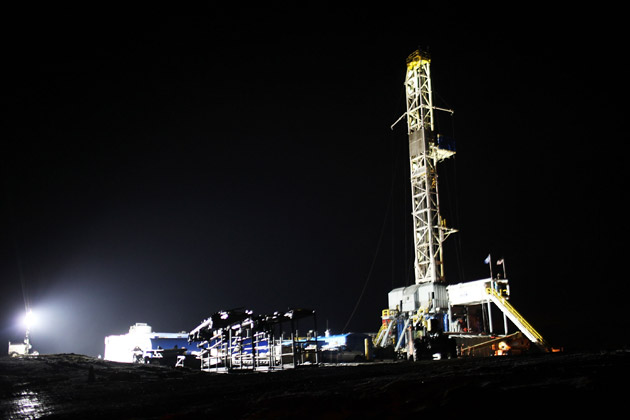
A Cabot Oil and Gas hydraulic fracturing site on Jan. 17, 2012, in Springville, Pa. (Spencer Platt/Getty Images)
by Abrahm Lustgarten
ProPublica, May 1, 2012, 4:29 p.m.
- 59 Comments
- Republish
A new study has raised fresh concerns about the safety of gas drilling in the Marcellus Shale, concluding that fracking chemicals injected into the ground could migrate toward drinking water supplies far more quickly than experts have previously predicted.
More than 5,000 wells were drilled in the Marcellus between mid-2009 and mid-2010, according to the study, which was published in the journal Ground Water two weeks ago. Operators inject up to 4 million gallons of fluid, under more than 10,000 pounds of pressure, to drill and frack each well.
Scientists have theorized that impermeable layers of rock would keep the fluid, which contains benzene and other dangerous chemicals, safely locked nearly a mile below water supplies. This view of the earth’s underground geology is a cornerstone of the industry’s argument that fracking poses minimal threats to the environment.
But the study, using computer modeling, concluded that natural faults and fractures in the Marcellus, exacerbated by the effects of fracking itself, could allow chemicals to reach the surface in as little as “just a few years.”
“Simply put, [the rock layers] are not impermeable,” said the study’s author, Tom Myers, an independent hydrogeologist whose clients include the federal government and environmental groups.
“The Marcellus shale is being fracked into a very high permeability,” he said. “Fluids could move from most any injection process.”
The research for the study was paid for by Catskill Mountainkeeper and the Park Foundation, two upstate New York organizations that have opposed gas drilling and fracking in the Marcellus.
Much of the debate about the environmental risks of gas drilling has centered on the risk that spills could pollute surface water or that structural failures would cause wells to leak.
Though some scientists believed it was possible for fracking to contaminate underground water supplies, those risks have been considered secondary. The study in Ground Water is the first peer-reviewed research evaluating this possibility.
The study did not use sampling or case histories to assess contamination risks. Rather, it used software and computer modeling to predict how fracking fluids would move over time. The simulations sought to account for the natural fractures and faults in the underground rock formations and the effects of fracking.
The models predict that fracking will dramatically speed up the movement of chemicals injected into the ground. Fluids traveled distances within 100 years that would take tens of thousands of years under natural conditions. And when the models factored in the Marcellus’ natural faults and fractures, fluids could move 10 times as fast as that.
Where man-made fractures intersect with natural faults, or break out of the Marcellus layer into the stone layer above it, the study found, “contaminants could reach the surface areas in tens of years, or less.”
The study also concluded that the force that fracking exerts does not immediately let up when the process ends. It can take nearly a year to ease.
As a result, chemicals left underground are still being pushed away from the drill site long after drilling is finished. It can take five or six years before the natural balance of pressure in the underground system is fully restored, the study found.
Myers’ research focused exclusively on the Marcellus, but he said his findings may have broader relevance. Many regions where oil and gas is being drilled have more permeable underground environments than the one he analyzed, he said.
“One would have to say that the possible travel times for a similar thing in Arkansas or Northeast Texas is probably faster than what I’ve come up with,” Myers said.
Ground Water is the journal of the National Ground Water Association, a non-profit group that represents scientists, engineers and businesses in the groundwater industry.
Several scientists called Myers’ approach unsophisticated and said that the assumptions he used for his models didn’t reflect what they knew about the geology of the Marcellus Shale. If fluids could flow as quickly as Myers asserts, said Terry Engelder, a professor of geosciences at Penn State University who has been a proponent of shale development, fracking wouldn’t be necessary to open up the gas deposits.
“This would be a huge fracture porosity,” Engelder said. “So I read this and I say, ‘Golly, does this guy really understand anything about what these shales look like?’ The concern then arises from using a model rather than observations.”
(400 Trillion Cubic Feet Fracking Uber $hill Terry Engelding sure ’nuff earns his keep)
Myers likened the shale to a cracked window, saying that samples showing it didn’t contain fractures were small in size and were akin to only examining an intact section of glass, while a broader, scaled out view would capture the faults and fractures that could leak.
Both scientists agreed that direct evidence of fluid migration is needed, but little sampling has been done to analyze where fracking fluids go after being injected underground.
Myers says monitoring systems could be installed around gas well sites to measure for changes in water quality, a measure required for some gold mines, for example. Until that happens, Myers said, theoretical modeling has to substitute for hard data.
“We were trying to use the basic concepts of groundwater and hydrology and geology and say can this happen?” he said. “And that had basically never been done.”
Chip Northrup
Cooperstown




{ 0 comments… add one now }