
Thousands of men, women and children killed, bombs dropped, beheadings on YouTube, millions displaced - over some competing natural gas pipeline routes. The Shia Gas Line vs the Sunni Gas Line - to Europe. Who the frack would have ever fracking guessed that ? The joker in the deck is Russia - that wants Mideast gas - both Arabian and Persian - to go through Russia to Europe. Because all the alternative gas pipeline routes from the Mideast to Europe go through an atavistic chaotic caliphate.
Two years after energy analysts were writing about this - the popular press has figured out what the Syrian Gas Pipeline War is about . . . gas pipelines - including lines that would go through Turkey and one that might even go through Russia. Imagine that.
GI boots on the ground for this hydrocarbon dog fight ? I think not.
The Syrian war often seems like a big confusing mess but one factor that is not often mentioned could be the key to unlocking the conflict. Some experts have pointed out that many of the key players have one thing in common: competing multi billion dollar gas pipelines routes from the Mideast to Europe.
In a nutshell, the Gulf Arabs and Turkey thought they had a deal with Assad to build a pipeline through Syria to Turkey - and on to Europe. At the last minute, he stiffed them and signed a deal with Iran on a competing gas pipeline - that bypasses Turkey. So the Gulf Arabs and Turkey bankrolled Sunni rebel groups in Syria to get rid of Assad: ergo The Syrian Pipeline War, which begat ISIS, the intervention of the US, Russia, UK, France, etc. Mideast Hydrocarbon War III
The likely winner ? As shown in the map below, one way to get Mideast gas to Europe is to bypass Syria and Turkey completely via Russia. Are we surprised ?
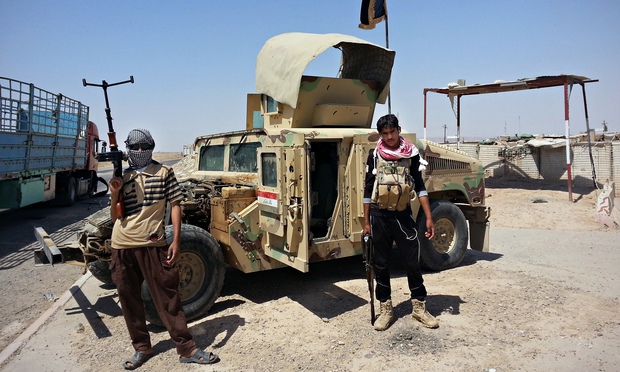
Perpetual hydrocarbon war in the Mideast - until they run out of gas or bullets.
Factor in this detail and suddenly the arc of the war and the actions of the players begins to make a lot more sense. Here’s how this all came about - and how it continues to unfold on a global scale:
IT’S THE GAS, STUPID
Many have questioned why Russia became involved in the Syrian war but often overlook the fight over natural gas.
As Harvard Professor Mitchell A Orenstein and George Romer wrote last month inForeign Affairs, Russia currently supplies Europe with a quarter of the gas it uses for heating, cooking, fuel and other activities.
In fact 80 per cent of the gas that Russian state-controlled company Gazprom produces is sold to Europe, so maintaining this crucial market is very important.
But Europe doesn’t like being so reliant on Russia for fuel and has been trying to reduce its dependence. It’s a move that is supported by the United States as it would weaken Russian influence over Europe.
This has not gone down well with Russia, which uses its power over gas as political leverage and has a history of cutting off supply to countries during conflicts. It has even gone to war in Georgia and Ukraine to disrupt plans to export gas from other parts of the Middle East.
As David Dalton, the editor of the Economist Intelligence Unit, told The New York Times: “Russia has always used gas as an instrument of influence. The more you owe Gazprom, the more they think they can turn the screws.”
Much of Russia’s power comes from established pipelines used to transport gas to Europe cheaply. But other countries are now trying to get around Russia and provide new sources of gas to Europe.
Last year US President Barack Obama spoke openly about the need for Europe to reduce its reliance on Russian gas following the conflict in Ukraine.
The US is not the only country trying to outmanoeuvre Russia, and this is where the role of Syria becomes more important.
TWO NEW PIPELINES
Before the civil war, two competing pipelines put forward by Qatar and Iran aimed to transport gas to Europe through Syria.
Qatar’s plans were first put forward in 2009 and involved building a pipeline from the Persian Gulf via Saudi Arabia, Jordan, Syria and Turkey.
The gas field located 3000 metres below the floor of the Persian Gulf is the largest natural gas field in the world. Qatar owns about two-thirds of the resource but can’t capitalise on it fully because it relies on tankers to deliver it to other countries and this makes its gas more expensive than Russia’s.
It was hoped the pipeline would provide cheaper access to Europe but Syrian President Bashar al Assad refused to give permission for the pipeline to go through his territory. Some believe Russia pressured him to reject the pipeline to safeguard its own business.
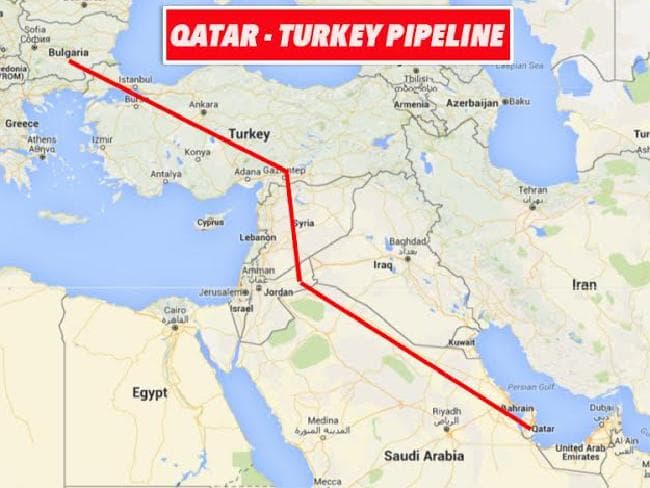
In the meantime Iran, which owns the other smaller, share of the Persian Gulf gas field, decided to lodge its own rival plan for a $10 billion pipeline to Europe via Iraq and Syria and then under the Mediterranean Sea.
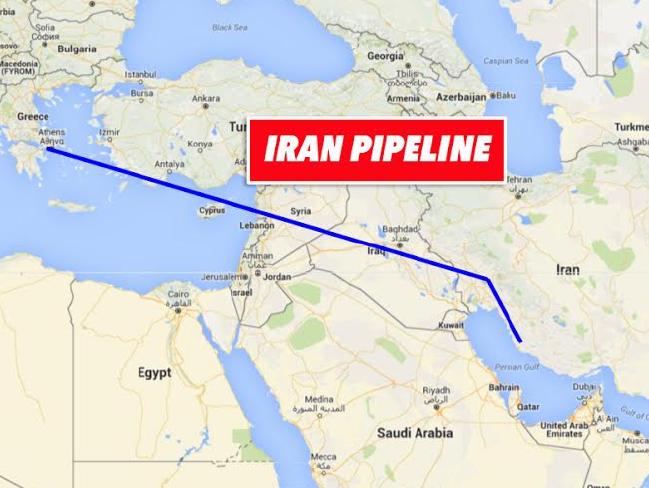
These plans apparently had Russia’s blessing, possibly because it could exert more influence over Iran, which, unlike Qatar, did not host a US air base.
Assad signed off on the Iran plan in 2012 and it was due to be completed in 2016 but it was ultimately delayed because of the Arab Spring and the civil war.
All of the countries supporting or opposing the war against Assad have links to these pipeline plans - either as gas customers (France, UK) competitors for the pipeline route (Turkey, Russia), or gas suppliers (Iran & the Gulf Arabs).
What would the US get out of if ? Not much. Just the ability to contain Russian’s gas hegemony in Europe. And the ability to try out some pricey new ordinance on live targets.
Failed pipeline bidder Qatar is believed to have funded anti-Assad rebel groups by $3 billion between 2011 and 2013. Saudi Arabia has also been actively funding the Syrian terrorist groups, including ISIS.
In contrast Orenstein and Romer noted the successful pipeline bidder, Iran, was believed to be helping Assad by running the Syrian army, supplying it with weapons and even troops.
Major Rob Taylor, an instructor at the US Army’s Command and General Staff College wrote in the Armed Forces Journal last year that the rival pipelines could be influencing the conflict in Syria, a year after that was common knowledge to the oil and gas industry.
“Viewed through a geopolitical and economic lens, the conflict in Syria is not a civil war, but the result of larger international players positioning themselves on the geopolitical chessboard in preparation for the opening of the pipeline,” he noted.
Just as the 2003 Iraq War has been linked to oil in the Persian Gulf, Syria may turn out to be all about gas.
One of the countries that has a lot to gain from getting rid of Assad is Turkey.
Turkish President Recep Tayyip Erdogan has been vocal in calling for the Syrian President to step down and has also been accused of helping Islamic State, something it has rejected.
While Turkey could have other reasons for supporting the rebels in Syria, such as Assad’s support for the Kurds, Harvard University Professor Orenstein told news.com.au that gas would definitely be one reason it was opposing the regime.
Turkey, which stands at the crossroads of Asia and Europe, is an aspiring member of the European Union, and some consider it to be the best option for facilitating the movement of gas supplies from the Middle East to Europe.
As a hub, Turkey would benefit from transit fees and other energy-generated revenues.
It could also insure, with US support, that all gas suppliers in the Middle East could freely export their product.
Qatar’s plans put Turkey at the centre of its plan.
As one of the countries relying on Russia for gas, freeing it from this dependence would be an added bonus.
But none of this can be realized if the pipeline bypasses Turkey and if Assad becomes instrumental in approving an alternative that does not involve it.
THE RUSSIAN CONNECTION
Now that Russia is stepping in to help the Assad regime in Syria in order to protect its own dominance in the European gas market — Turkey is facing a formidable barrier to its aspirations as the conduit for Arab gas. Russia simply wants to be a spoiler on both the Arab and Iranian Syrian/ Turkey gas lines - so that all of the Mideast gas goes north - through Russia, via Iran, Georgia and Azerbaijan - to get to Europe as shown below. These are oil pipelines shown - no one in the media has drawn the Iranian Russian Gas Line from the Mideast to Europe. All the prospective lines shown in the mainstream media go through either Turkey or Syria. None of them go the obvious 3rd way - via Russia.
Once it becomes clear that the Syrian route will not be politically stable (viz. Afghanistan), Russia may be the only viable way to get Mideast gas to Europe. And once that is a fait accompli, the Gulf Arabs may be compelled to transport through that Iranian Russian line, since the one thing the Gulf Arabs love more than they hate the Persians is money.
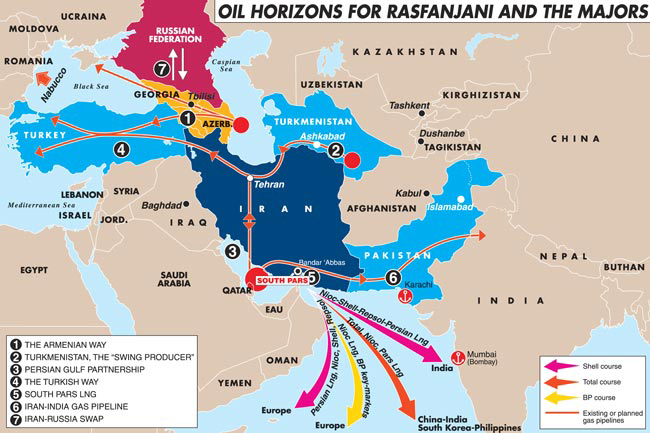
Through Russia With Gas- The Iranian Georgian Russian Line.
When Turkey downed a Russian plane earlier this month, some speculated it may want to weaken any potential co-operation between Russia and the US which could see Assad continue his leadership.
Russia’s motives for its air strikes have also been questioned. CNN military analyst Cedric Leighton, a retired air force colonel, noting that its bombing of Islamic State extremists seemed to have hit Turkmen in northern Syria, who had strong ties to the Turkish government.
Prof Orenstein said the competition over natural gas could ultimately prevent co-operation between the two world powers on fighting Islamic State.
“I doubt there is much basis for US-Russia co-operation due to opposite interests in gas issues and Iran,” he told news.com.au
But despite fears that the world is facing a new Cold War, Prof Orenstein believes it’s more of a “free for all”, with the fight over natural gas acting as if its’s just another fossil fuel to die for.
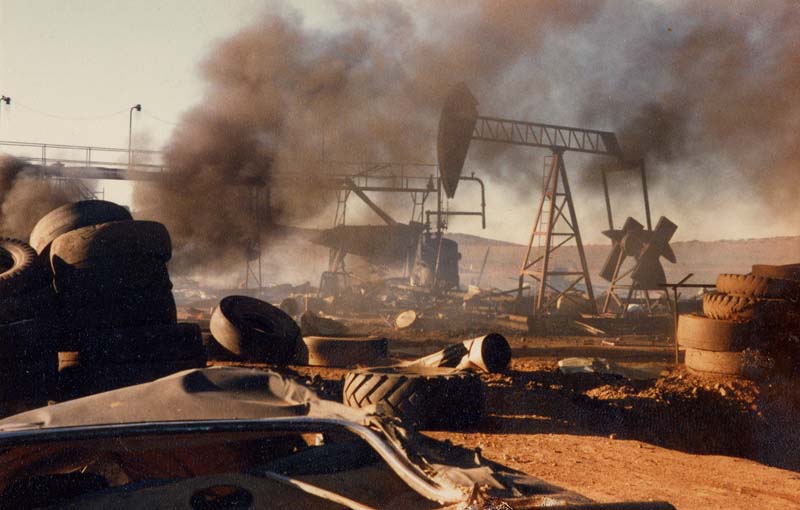
Road Warrior. The war, not the movie. US boots on the ground sound good to you for this fracking mess ?


John Dale "Zach" Lea says
Why not go through Jordan or Egypt and the Mediterranean?
Good question. Not in the Russians’ (Gazproms’) interest for either of the two competing lines to be built.
They would want the Iranian line to go north - into Russia.
After Assad falls and they lose Syria as a client state - watch that happen.
craig says
This article forgets to add one of the most important related facts- Murdoch and Rothschild have the first mining rights for the Golan Heights. This is why the mainstream media has been so complicit in spruiking the false reasons for ‘terrorism’, and stirring up anti-muslim sentiments globally.
Way off the point, but you get the idea - what goes on below the surface (pun intended) is what has been driving this from the start of the Syrian up-rising, the day after Assad jilted the Arabs and cut a deal with Iran on the gas line.