
 One of the talking points touted by the fossil fuel industry is in regards to how many jobs it will create. When people hear the numbers, they are thinking these are jobs directly related to fossil fuels, like workers on a drill pad, or construction of pipelines.
Former Pennsylvania Governor Tom Corbett often boasted the shale industry had created 200,000 jobs in Pennsylvania. This conflicts with the 28,000 jobs reported by the Pennsylvania Department of Labor and Industry (DOL).
Why the difference in numbers? The 200,000 number often cited includes what the industry calls “support” or “ancillary” jobs, whereas the DOL number of 28,000 is directly related to the industry’s activities.
According to Pennsylvania Department of Labor and Industry report for new hires in 2014 there were 6,844 Pipeline related jobs.
NEW HIRES are not NEW JOBS.
DEFINE THE TERMS
New Hires are defined as someone who either hasn’t previously been employed by the business, or was formerly hired by the business but has been separated from such prior employment for at least 60 consecutive days. NEW JOBS would be hiring people to fill positions not previously in existence.
NEW JOBS do not necessarily translate to an overall increase of employment. One company could actually be creating new jobs while another company could be cutting its workforce. If Company A cuts its workforce by 5 employees and Company B increases its workforce by 5 employees, the net increase is zero.
The DOL defines directly related jobs in these six “core” industries related to fossil fuels:
- Crude petroleum and natural gas extraction
- Natural gas liquid extraction
- Drilling oil and gas wells
- Support activities for oil and gas operations
- Oil and gas pipeline and related structures
- Pipeline transportation of natural gas
The state Department of Labor and Industry also counts workers in 30 “ancillary” (or related) industries. This number captures everyone in those industries– including every road construction worker, trucker, engineer, and steel worker in Pennsylvania whether or not a worker actually works on a fossil fuel project. So a trucker who may not be making pick-ups/deliveries to a fossil fuel project, but works for a trucking company which does occasionally service a fossil fuel project is counted in the “ancillary” numbers.
These numbers DO NOT capture so-called “induced” of “supported” jobs, which include spillover benefits. For example, jobs at a hotel or a restaurant seeing more business due to proximity to gas development.
However, the industry produced economic reports and press releases will include “induced/supported” jobs to pad their numbers by including such occupations as strippers and prostitutes.
As a side note, although not citing any numbers, the Kinder-Morgan company, in its 2013 application to build the Trans Mountain Pipeline in Canada stated:
Spill response and clean-up creates business and employment opportunities for affected communities, regions, and clean-up service providers, particularly in those communities where spill response equipment is, or would be, staged
“WHAT IF” MODELING
Economic modeling is essentially asking “what if”. What if we include these numbers, what if we don’t include these numbers, what if these numbers were really ‘x’?
A 2011 Working Paper from Cornell University describes economic modeling: (emphasis added)
“For policy makers and citizens, the utility of the information provided by these Economic Impact Reports (EIRs) depends on a clear understanding of the limitations of input/output models and what they can and cannot tell us. For example, while the models estimate the number of jobs that could be created with a certain level of expenditures…., they cannot tell us how many actual jobs will be created, who will get those jobs, or what they will pay. The fact that input/output models can only provide job estimates is often ignored, and those estimates are portrayed incorrectly as real job numbers. In addition, because of the simplifying assumptions necessary to construct input/output models, they cannot be used to analyze wide-ranging structural changes in a regional economy”
PENNEAST and TACOS
With much media splash, PennEast released their Economic Development Analysis, on February 9, 2015, one day ahead of the start of the Federal Energy Regulatory Commission’s (FERC) Environmental Impact Scoping (EIS) hearings. The timing of the release left people with little time to read, let alone analyze the report if they wished to comment on it at the EIS hearings.
The report was produced by Econsult Solutions, Inc. and Drexel University School of Economics at the request of PennEast.
The media in general splashed headlines of 12,000 jobs will be created by PennEast pipeline with little investigation as to what the number really means.
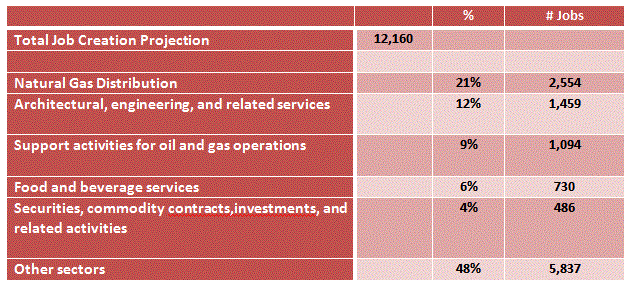
Above is a chart of “Job Creation Projections” based on the PennEast report. Approximately 10,000 of the projected jobs are not directly related to the actual construction of the pipeline, and almost half of the total is attributed to “other sectors” without any examples of just what other sectors mean.
Kudos to New Jersey On-Line (NJ.com) which did ask about the indirect jobs: (emphasis added)
The project would employ 2,500 temporary construction workers to actually build the pipeline, a task expected to take about seven months, said to Patricia Kornick, PennEast spokeswoman.
The remainders of the 9,960 jobs cited in the Drexel study are ancillary positions created by the $1.6 billion in economic activity generated by the construction, Kornick said.
“The other jobs would be across other supporting industries,” Kornick said.”There would be consulting and architectural, food services and other sectors.”
For instance, if the operator of a taco truck pulled up to a construction area to feed hungry workers at lunchtime, that operator would be counted as one of the 12,160 jobs “supported” by the a pipeline, under the formula employed by the Drexel study.
“That would fall under the food services category,” Kornick said.
Patricia Kornick, media and community relations for PennEast, did not specify how many tacos would need to be sold to hungry PennEast workers to qualify a food truck operator as a supporting industry. According to Kornick, actual construction of the PennEast pipeline is expected to take about seven months. A food truck operator which bases its operations on a 7 month construction job has a very poor business model.
Peter Terranova, chairman of the PennEast Pipeline board of managers said Monday (Feb. 9, 2015) while touting the study.
“Drexel’s analysis illustrates the substantial economic benefit of the PennEast Pipeline. As a large infrastructural improvement project, it will support thousands of jobs and generate more than a billion and a half dollars of economic activity in Pennsylvania and New Jersey.”
If the job numbers cited in the report are questionable, then the overall economic benefit figures are also questionable. Remember the Cornell 2011 working paper stated “while the models estimate the number of jobs that could be created with a certain level of expenditures…., they cannot tell us how many actual jobs will be created, who will get those jobs, or what they will pay. The fact that input/output models can only provide job estimates is often ignored, and those estimates are portrayed incorrectly as real job numbers.”
How many Pennsylvania and New Jersey Workers and beyond.
Looking at directly related jobs to the PennEast Pipeline, how many of these will be employing workers who reside in Pennsylvania and New Jersey? The report doesn’t say.
It does state in Section 3.4, Design and Construction Economic impact : (emphasis added)
“The workforce for the Project is likely to be comprised of personnel from across the country due to the specialized nature of pipeline construction.”
The public is further misled in believing local workers will be getting these jobs.
As stated by Kornick, the pipeline construction is expected to take seven months. What happens after that? We know the 2,554 construction jobs go away upon completion of a project. What about the remaining 12,062 jobs including the one held by the Taco truck?
According to PennEast/Drexel report there would be 98 jobs left. If we are to believe 12,160 jobs will really be created, the sudden loss of 12,062 jobs at the completion of the project is a cause for concern regarding employment in Pennsylvania and New Jersey.
The 98 jobs figure also relied on the same ancillary formula used in the model, so is it even correct? Apparently not. Kornick said 21 permanent jobs would be directly dedicated to upkeep of the pipeline.
What about the other 77 jobs? More Taco trucks?
FOR NOW
If PennEast is promoting fudged economic benefit figures, how much else is being fudged?
PennEast claims the natural gas will benefit consumers. Although Penneast does not explicitly define “consumers”, the public is led to believe there will be PennEast pipeline service to their homes. PennEast natural gas to your home? Not going to happen. PennEast is an interstate transmission line, NOT a service line.
Where is the natural gas really going? Not to consumers as the public thinks of as consumers. In November 2014, Kornick stated: (emphasis added)
“This natural gas line is not for exports. For now it is for Pennsylvania and New Jersey utility companies only.”
PennEast limits its definition of consumers to utility companies.
Another issue surrounding PennEast is whether or not the natural gas will be exported. Kornick did state the pipeline is not for exports, however, the qualifier words of FOR NOW leaves the door open for exportation at a future date.
THERE WILL BE OPPOSITION
We’ve seen these rainbow and sunshine job creation numbers, not only from PennEast, but also from the industry as a whole. If the job creation numbers claimed by the industry are true, then we need to ask why Pennsylvania is ranked is 50th in the nation for job growth, and why are areas where active natural gas industrialization is occurring have employment rates on par with the national and state employment figures.
At a National Press Club luncheon, Cheryl LaFleur, Chairperson of FERC stated that Pipelines are facing unprecedented opposition and we have a situation.
Yes, Cheryl, we do have a situation.
We have a situation when the industry produces misleading reports and promotes them as fact.
We have a situation when elected official tout the misleading reports as fact.
We have a situation when governmental agencies and departments rubber stamp projects based on misleading reports.
We have a situation when trust and credibility at all levels of government and industry has been lost.
In such a situation, there will be unprecedented opposition.
©2015 by Dory Hippauf


Why stop at ‘thousands’ for the Support and Ancillary jobs? Since our entire economy is inter-connected, all the money earned through each ‘job’ doesn’t stay within the area in which it was ‘created’. Many of the out of state workers send money home, where it gets spent there. Many of the companies are based in other states, and that’s where the larger portion of their profits go, and even investments of that money go to some other project in yet another state. The Natural Gas Industry: Supporting millions and millions of jobs all across the United States.