



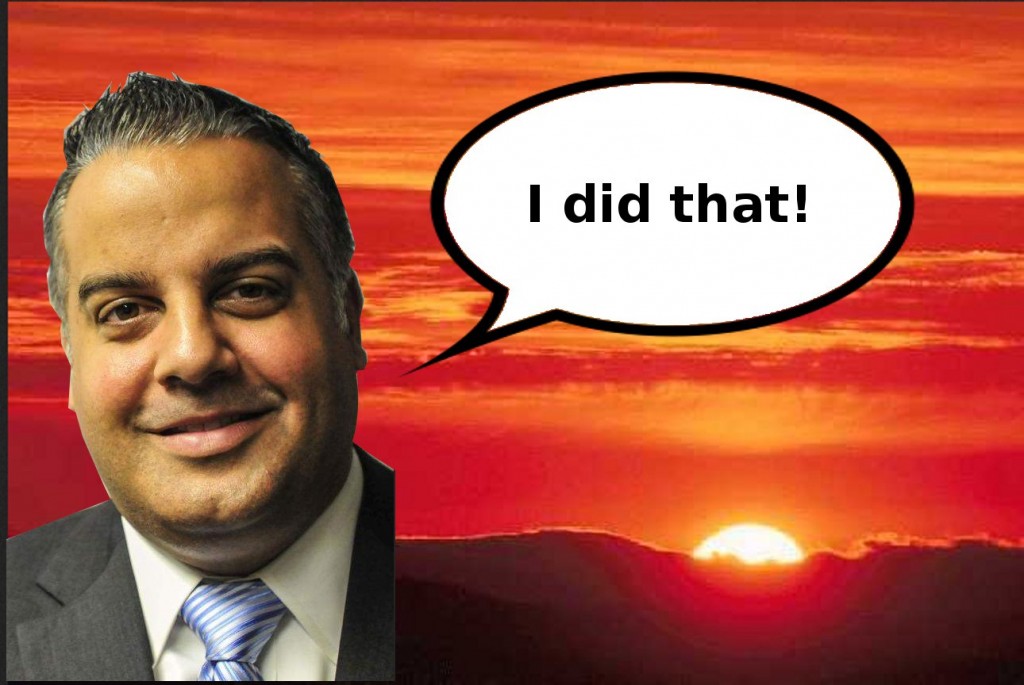
Many local media are reporting that incoming Binghamton Mayor Rich David cancelled the appeal of the court decision which overturned the Binghamton moratorium on a technicality. e.g.,
BINGHAMTON — Within 10 days of taking over City Hall, Mayor Rich David dropped the appeal of a court decision striking down the moratorium on oil and gas drilling in Binghamton. — “Binghamton withdraws fracking-ban appeal“, Binghamton Press and Sun Bulletin. 1/15/14
http://www.pressconnects.com/article/20140114/news01/301140034/binghamton-withdraws-fracking-ban-appeal
Only thing is, the Binghamton moratorium expired on December 31, 2013. So basically, Rich David is trying to impress his pro-drilling friends at the Greater Binghamton Chamber, who put him in office, by claiming credit for cancelling an appeal which is moot. He might as well take credit for the sun setting. (No Rich, it was going to do that anyway!)
The other thing he gets wrong is saying,
“Even if the state does approve it in the future, there will never be fracking in the city,” said David. “The only pieces of land large enough for a well to be built in the city are on public property and he says that will never be permitted.” — WBNG, “Mayor David: Binghamton will never frack”
http://www.wbng.com/news/local/Mayor-David-Binghamton-will-never-frack-240182771.html
Oh yeah? Why is that? Is that a promise of yours? Because there is urban drilling everywhere else in the world, why not Binghamton?
If you want the facts, read this, by David Slottje:
Binghamton Lawsuit Update
The Law was not styled as a moratorium or a zoning amendment, nor did it purport to rely on any zoning power for authority. Rather, the Law relied on specified sources of authority tied to protecting the federally designated, sole-source aquifer that underlies portions of the City.The law had a stated effective period of two years; that is, it ran through all of 2012 and 2013, and by its explicit terms expired on December 31, 2013.
The Lawsuit Challenging the City’s Law
In May of 2012, five parties acting together brought suit to invalidate the Law. Very briefly, the suit alleged three – and only three - causes of action. The three causes of action were:1. that otherwise existing local (municipal level) authority to pass such a law had been preempted by a state law [ECL 23-0303(2)] which reserved to the DEC the sole authority to regulate the gas industry;
2. that the Law was in reality a zoning amendment, and as such ought (by virtue of a provision of the City’s zoning code) to have been referred to the City Planning Commission for an advisory opinion prior to enactment by the City Council; and
3. that the Law was in reality a zoning amendment, and as such ought (by virtue of General Municipal Law 239-m) to have been referred to Broome County Planning Commission for its recommendation prior to enactment by the City Council.
The City filed a Motion to Dismiss pursuant to which the City asserted, among other things, that causes of action #2 and #3 above were time-barred, as suit had been brought after expiration of the applicable (four months) statute of limitations.
The Decision by the Lower Court
In October of 2012 Judge Lebous (Broome County Sup. Ct.) issued his decision.
Of foremost importance – and contrary to what various pro-frack bloggers claim – the judge specifically held thatlocal, municipal authority to enact laws prohibiting drilling-related activities was NOT preempted by ECL 23-0303(2). In his decision, the judge in the Binghamton case explicitly adopted as his own “the well reasoned, well founded decisions” of the Dryden and Middlefield courts.
And the judge also agreed with the City that the challengers’ claims regarding referral to City Planning and County Planning were barred by the statute of limitations.
This thus meant that all three of the challengers’ causes of action were thrown out.
However, the judge then proceeded to invalidate the City’s Law on a ground that had not been not set forth in any of the petitioners’ three causes of action.
More specifically, he held that the challenged Law was, in actuality, a moratorium, and held that the City could not possibly satisfy the judge’s requirements for a valid moratorium because, according to the judge, no [gas drilling] permits are being granted by the DEC, and natural gas drilling cannot (presently) occur in this state.
[[Of course, drilling permits had been and were being issued by DEC, and of course gas drilling can and is taking place in NYS.]]
Status of the Appeal
By late summer of 2013, the parties had filed their briefs with the Appellate Division, Third Department, and oral argument in the case has been scheduled by that court to take place on February 20, 2014.
However,Binghamton Mayor Matthew Ryan’s term of office expired at the end of 2013, and he was term-limited so did not run for re-election. A new mayor took office in January, 2014, and the new mayor directed that the City’s appeal in this matter be withdrawn.
So, What does this Mean?
The pro-frack bloggers have lit up the interwebs with their posts, gleefully asserting that the new mayor’s decision to withdraw the City’s appeal somehow invalidates the City’s law, and that JudgeLebous’ articulation of what is and what is not required for a valid municipal moratorium inNYS somehow becomes the ‘law of the land.’As usual when these pro-frack bloggers weigh in on what the law is or is not, they are not even close to correct.
First, the fact that the appeal was withdrawn does not in any manner, shape, or form invalidate or otherwise affect the status of the challenged law. It became effective when enacted, and was in effect through the entirety of it stated term. It was always intended to expire on December 31, 2013, and that is when it did expire. It did not become ineffective when the suit challenging it was brought, and it certainly did not somehow become invalidated retroactively – after its stated expiration date – because the new mayor elected to withdraw the City’s appeal after he assumed office in January 2014.
Second, the fact that the new Mayor has withdrawn the City’s appeal does not somehow magically accord the lower court’s decision the precedential weight of an appellate-level decision.
Remember when the frackers lost the Dryden decision regarding local-level legal authority to pass these protective laws? Then, the frackers criticized the judge there, and said “it’s only one (lower court) decision; let’s wait for the decision in Middlefield.”
When they lost again on whether municipalities had legal authority, in the Middlefield case, once again they said “The Middlefield decision is not dispositive, it’s only a lower level case.”
When they lost on the question of municipal authority still again, in the subject Binghamton case, at first they denied that they had lost, and then they said, “Hey, that’s only one more lower court case, and it certainly is not controlling precedent anywhere.’’
“We will wait,” they said, for a case “in the western part of the state; the judges there understand drilling, and the opinions of judges there are what matters.”
But then they lost again on the question of whether municipalities may enact these laws, this time in the Avon decision, by a lower court in the western part of the state.
So then they switched tactics: “Lower court cases (even when a number of them from various parts of the state agree) don’t matter, and aren’t binding,” they said. “Let’s wait for the appellate division to weigh in.”
And then, when the appellate court unanimously upheld local authority to enact these laws, they said “That appellate court is not the last word; nothing less than a pronouncement from the highest court in the state (the Court of Appeals) matters.
And so on.
So, someone should ask the blogging frackers: Why is it when one, and then another, and then another, and then another lower court case goes against you, and then two appellate decisions go against you – unanimously – your position is that trial court decisions don’t count for anything, and even unanimous appellate decisions don’t count for anything, but you raise your voices to the heavens and proclaim a decision that both sides were appealing (but which for mootness or other reasons was removed out of the appellate queue) as some sort of definitive and controlling legal precedent?
Dream on.
The fact that the new mayor elected to withdraw the appeal did not somehow retroactively invalidate the City’s law. It remained in full force and effect at all times during its stated term, and you can’t change that fact or make it disappear by wishful thinking.
And the value of the lower court’s decision as precedent was not and is not somehow elevated by virtue of the fact that the appeal has been withdrawn.
Our view, respectfully, is that the judge’s decision (below) as to what the requirements of a valid moratorium are was no more correct than his statements – on which his holding is based, by the way – ‘that the DEC is not issuing drilling permits,’ and ‘that no drilling is presently taking place’ in NYS. (Drilling is in fact taking place in NYS, and I have on my desk copies of drilling permits issued by the DEC both before and after the date of Judge Lebous’ decision.)
- See more at: http://cedclaw.hs-sites.com/news/binghamton-lawsuit-update


{ 0 comments… add one now }