

Fracking Fairy
One fracking fable at a time. The New York Shale Gas Potential presentations planned for New York City on January 16th and at the Foothills Center in Oneonta on the following night, and Vestal on the 31st, will shed some light on where shale gas might be produced in the state, how much might be produced, and what impact that might have, including the collateral damage of fracking. Relying on industry data, including information that has not been publicized by industry lobbyists and PR people, we are going to do some shale gas myth-busting. Three groups in particular have not been thrilled with our presentations – the local landowners leasing groups, the gas lobbyists, and some of the more strident FERC pipeline opponents. The opposition from the first two groups – the fracking wannabes and the frack flaks – is understandable: we are bursting their hot air balloon in broad daylight. Their reaction was predictable but has been entirely rhetorical, they can’t dispute what we say geologically, they just don’t want us to say it at all.
The fracking front group, Energy in Depth video’d our Cornell presentations but has curiously avoided putting any of the videos online. Wonder why. The videos can be found here. http://tinyurl.com/
nyshalegaspotential
The leasing groups think that we’re hurting their chances to lease their mineral rights – but the industry already knows that most of Upstate is not worth leasing: beyond a few townships north of the borderline there’s simply not much shale gas worth fooling with. The further away you get from Fracksylvania’s Ground Zero, the more delusional the leasing groups become; Chenango County may be the fracking lunatic fringe going north. Chemung County going east. Any landowner in Sullivan County that thinks they’re going to lease for shale gas any decade soon should probably be committed. Consequently the leasing groups have been reduced to putting on publicity stunts for shale shysters.
The fracking lobbyists are already in a tail spin over the public’s lack of interest in fracking the state, so broadcasting that New York has little shale gas potential is not conducive to their credibility or livelihood. Accordingly, with the exception of a few cursory remarks from New York Independent Oil & Gas Association (IOGA), the lobbyists have been silent on the matter. They’re just paid to lie, not be geologists. And lie they have - by grossly overstating New York’s shale gas reserves. The DEC’s “economic impact study” of shale gas was based on wildly inflated estimates that they got from the shale gas lobby, as detailed here. IOGA’s “low” estimate of 40Tcf for New York was half the USGS’s estimate for the entire Marcellus - in Ohio, W. Va,, Fracksylvania and New York. IOGA’s high estimate for NYS was half of Terry Engelder’s estimate for the entire Marcellus. There are lies, big lies, and then there are lobbyist’s lies.
The opposition from the stop-the-pipeline people is a bit harder to fathom. It seems that some of them have thoroughly convinced themselves that the proposed interstate gas transmission lines are a subterfuge to frack the areas along the route – that, in effect, pipelines “cause” fracking, that a pipeline is a Trojan Horse for fracking the adjacent area. That is not exactly how it works, but telling them they are wrong on this point is like telling a hypochondriac they’re not sick. They’re not overly inclined to address the geological facts if that gets in the way of their sales pitch.
The threat of being fracked is a powerful motivator. Indeed, the newest political epithet in Albany is “fracking lobbyist.” So in order to drum up opposition to the pipelines the opponents have told people that the pipelines will open up new areas to fracking. This is partially true, if there is a pipeline handy, a shale gas area, including a marginal area, is more likely to be developed. But that, of course, is a function of there being any shale gas there in the first place. Evidently some of the pipeline opponents have gotten a bit fuzzy on that last point – implying that there is shale gas potential where none exists.
They claim that some areas may not be fracked at $4 mcf, but will if gas spikes to say $10 mcf. They must have missed slides #3-87 of our presentations. In most of Upstate, there is no shale gas potential at any price. $10 per thousand cubic feet x 0 cubic feet = 0. Nothing times nothing equals nothing. Zero shale gas potential means just that. That comes as good news to most local fractavists - but evidently not to the ones who have been telling people that the pipeline would lead to fracking where there is no shale gas.
There is little correlation between shale gas reserves and the pipeline route in New York as the map below shows. If the New York route was a subterfuge to frack the landscape along the way, the pipeline companies – Williams, Cabot, etc. would have already optioned or leased the mineral rights along the way. They have not, for the simple reason that there is no shale gas potential along much of the route – despite what some pipeline opponents may have lead people to believe. Unable to contradict our findings, some pipeline opponents have called for a boycott of our presentations. That should boost attendance !
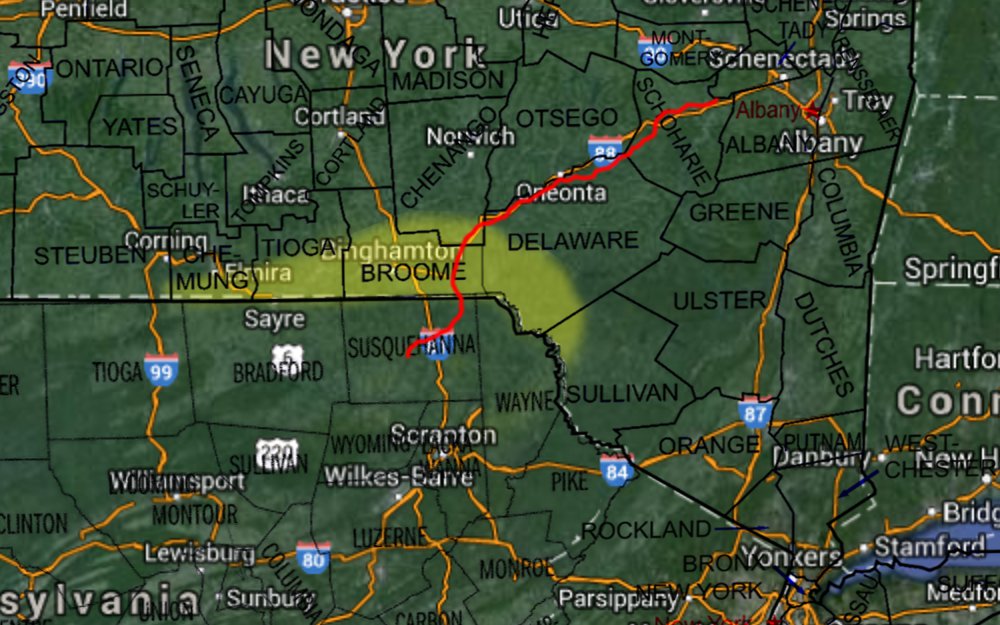
A federally regulated interstate gas transmission line has to be contested based on its own merits or lack thereof. The presence/absence of shale gas potential along the route does not control regulatory approval - if the line’s economic viability is not predicated on it. If regulatory approval is not dependent on tapping gas reserves in New York, then why are the opponents making an issue of it ? If regulatory approval is in fact predicated on tapping shale gas fields in New York State, then why would the opposition boycott our work ?
We are not unmindful of the plight of people in harm’s way of the pipeline and its compressor stations. Indeed we have addressed those very issues in some detail on this site many times. I even published a paper encouraging resistance to the pipelines via forced condemnations. So I have done my bit to try to deal with pipelines.
Most of Upstate has no upside with shale gas. Only downside – spreading frack filth on the roads, dumping radioactive drill cuttings in landfills and trucking frack flowback to municipal water plants. That collateral damage can be addressed by county, town and state ordinances. There is no need to pretend that your town or county is going to be fracked in order t0 prohibit such collateral damage. Just do it. Pass an ordinance to prohibit frack waste spreading on roads, dumping it in landfills, or in water treatment plants. While you are at it, pass an ordinance to prohibit fracking, so that you don’t have put up with prospectors like Norse Energy drilling wildcat wells looking for something that’s not there.
Come to one of the presentations and decide for yourself. NYC on January 16th at 6:30 at Ethical Culture on 64th.
Oneonta Foothills Center on the 17th, or Vestal on the 30th.
Ask questions. Bring a Doubting Thomas. Hope to see you there.
Check out the FB link here - (4) New York Shale Gas Potential: How Does it Compare to Pennsylvania?

New York Shale Gas Potential


Brendan O'Connor says
“…A federally regulated interstate gas transmission line has to be contested based on its own merits or lack thereof. The presence/absence of shale gas potential along the route does not control regulatory approval - if the line’s economic viability is not predicated on it. If regulatory approval is not dependent on tapping gas reserves in New York, then why are the opponents making an issue of it ? If regulatory approval is predicated on tapping shale gas fields in New York State, then why would the opposition boycott our presentations ? Not much here to tap…”
The presence or absence of shale gas along the proposed route and the economic viability of its production may not be within FERC’s official criteria for approval of the Constitution Pipeline project, but that doesn’t necessarily apply to the industry’s motives for building it. Regardless of the current publicly available predictions of hydrocarbon content of all of the hydrocarbon bearing formations including the sandstones and Utica and Marcellus shales, their actual reserves may yet be profitable for the industry to extract and ship someday. Whether there is gas along the route and whether or not its production and transmission would be economically feasible aren’t the only reasons for opposing this pipeline. Why should we allow the pipeline builders to use the power of FERC to bully their way into convincing land owners to grant property devaluing easements along the proposed routes? Why should we allow this industry to establish a presence in our area? If there are economically recoverable reserves here, an open access pipeline such as this could make it profitable enough for the industry to produce and transmit those reserves. If there are no economically recoverable reserves here, allowing a pipeline to pass through still compromises our air and safety. This pipeline would also help the industry to continue and expand its destructive extractive processes that are happening in states south of here.
Chip, I appreciate the work that you and the other presenters have done in the past. I am very appreciative of your moderator’s past work. Dr. Ingraffea has given us insightful presentations on the subject of gas extraction. I am especially grateful for his explanations of the inherent fallacies of well construction- http://www.youtube.com/watch?v=N60hcRzAK_0 , as well as your informative posts and presentations on the subject.
We need to say no to all expansion of industry infrastructure, especially gas storage and large transmission lines that would carry gas to domestic markets and to future export LNG facilities. We need to say no for the sake of our own health and security and for the health and security of people living in the areas where extraction is happening and in areas where the industry intends to extract in the future.
A federally regulated interstate pipeline has to be opposed based on its merits or lack thereof. Regulatory approval of that line is not predicated on New York state shale gas reserves. Would not mislead people into believing otherwise. If you have anything that contradicts our work,you should show it.
Hope to see you at the show. Bring a skeptic and ask questions about the material presented: New York’s shale gas reserves. Not about the approval process of federally regulated pipelines. That is not what these presentations are about.
If protesting a pipeline is your focus, best deal with it head on via the regulatory process - no tangentially here. If you want to talk about pipelines, please do so under one of the many blogs that address that subject. Thanks.
One of the most interesting of the aspects of this is the staggering amounts of land and subsurface leases held by the industry IN the fringe zone. Hartz has purchased the former Norse rights and leases, making them the largest individual land owner in Chenango County and in some parts of Broome County (http://nyshalegasnow.blogspot.com/2012/05/new-entries-in-upstates-shale-gas.html). They’re still selling off surface rights and properties, but keeping the subsurface and mineral rights. Either they can afford to be patient (and they can afford it) until other plays dry up, or they somehow believe that there’s gas in them thar hills.
I plan to try to attend the event in Oneonta. But what would be REALLY interesting is to see a moderated discussion and lecture by this panel and a panel of current proponents and industry experts. (Experts, not paid shills or landowner coalition folks. Actual geologists, economists, and engineers currently working in the industry.) I suspect the Great Pumpkin will arrive long before that ever happens.
See you at the show, Butch.
We have had no credible industry petroleum reserve engineer contradict any of our conclusions. Because our conclusions are the same as the petroleum reserve engineers that have looked at New York: the only viable shale gas is at the borderline. Lou uses industry geological maps to reinforce that point. So the only tepid push back we’ve gotten have been from some 3rd string frak flaks, which, of course, is meaningless - they’re paid to lie. No group that has criticized our work has shown us anything that would contradict our findings.
As to Hartz - there’s another sucker born every minute - and all Hartz has to do is find one. Most of Chenango County is devoid of shale gas. Broome has potential right at the border - after all the Fracksylvania gas fields are played out.
Pat Roberts says
The presentation in Vestal is Friday, January 31.