
We all now know that Bush Cheney invaded Iraq for the oil. (Surprised ?) Then Cheney gave his company, Halliburton, a no-bid contract to secure the oil fields. But The Thieves of Bagdad fooled them. The Iraqis leased all their southern oil reserves to the Chinese. Because the Chinese paid The Thieves of Bagdad bigger bribes. So all those US Marines, Army Reserves and GIs died in order to make it safe for the Chinese to frack Iraq.
The Chinese got the southern Iraqi oil concession because they don’t have any restrictions on bribing government officials - like US public companies. Such as Halliburton or Exxon.
So who got the northern Iraqi oil field concession ? Hunt Oil. A private Dallas oil company owned by Ray Hunt, Bush Jr.’s biggest benefactor. Who then promptly flipped it to Exxon Mobil’s shale gas subsidiary XTO. And no, Ray won’t be sending any thank you notes to the families of those dead GI’s. Not his style. He just built the Bush Library. That was his thank you note.
Halliburton wised up and moved its corporate headquarters offshore to Dubai. So now they don’t have to deal with US anti-bribery laws. Or pay taxes.
And the Chinese are buying up US shale reserves. Using the same business model that won them the concession in Iraq. One fat envelope at a time.
Are we surprised ?
China Is Reaping Biggest Benefits of Iraq Oil Boom
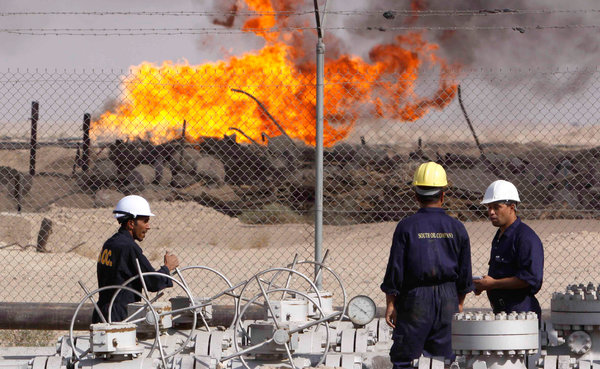
An oil refinery in Basra, southeast of Baghdad, in which China has a stake. China has poured money and workers into Iraq.
By TIM ARANGO and CLIFFORD KRAUSS
Published: June 2, 2013 551 Comments
BAGHDAD — Since the American-led invasion of 2003, Iraq has become one of the world’s top oil producers, and China is now its biggest customer.

Readers’ Comments
Share your thoughts.
- Post a Comment »
- Read All Comments (549) »
China already buys nearly half the oil that Iraq produces, nearly 1.5 million barrels a day, and is angling for an even bigger share, bidding for a stake now owned by Exxon Mobil in one of Iraq’s largest oil fields.
“The Chinese are the biggest beneficiary of this post-Saddam oil boom in Iraq,” said Denise Natali, a Middle East expert at the National Defense University in Washington. “They need energy, and they want to get into the market.”
Before the invasion, Iraq’s oil industry was sputtering, largely walled off from world markets by international sanctions against the government of Saddam Hussein, so his overthrow always carried the promise of renewed access to the country’s immense reserves. Chinese state-owned companies seized the opportunity, pouring more than $2 billion a year and hundreds of workers into Iraq, and just as important, showing a willingness to play by the new Iraqi government’s rules and to accept lower profits to win contracts.
“We lost out,” said Michael Makovsky, a former Defense Department official in the Bush administration who worked on Iraq oil policy. “The Chinese had nothing to do with the war, but from an economic standpoint they are benefiting from it, and our Fifth Fleet and air forces are helping to assure their supply.”
The depth of China’s commitment here is evident in details large and small.
In the desert near the Iranian border, China recently built its own airport to ferry workers to Iraq’s southern oil fields, and there are plans to begin direct flights from Beijing and Shanghai to Baghdad soon. In fancy hotels in the port city of Basra, Chinese executives impress their hosts not just by speaking Arabic, but Iraqi-accented Arabic.
Notably, what the Chinese are not doing is complaining. Unlike the executives of Western oil giants like Exxon Mobil, the Chinese happily accept the strict terms of Iraq’s oil contracts, which yield only minimal profits. China is more interested in energy to fuel its economy than profits to enrich its oil giants.
Chinese companies do not have to answer to shareholders, pay dividends or even generate profits. They are tools of Beijing’s foreign policy of securing a supply of energy for its increasingly prosperous and energy hungry population. “We don’t have any problems with them,” said Abdul Mahdi al-Meedi, an Iraqi Oil Ministry official who handles contracts with foreign oil companies. “They are very cooperative. There’s a big difference, the Chinese companies are state companies, while Exxon or BP or Shell are different.”
China is now making aggressive moves to expand its role, as Iraq is increasingly at odds with oil companies that have cut separate deals with Iraq’s semiautonomous Kurdish region. The Kurds offer more generous terms than the central government, but Iraq and the United States consider such deals illegal.
Late last year, the China National Petroleum Corporation bid for a 60 percent stake in the lucrative West Qurna I oil field, a stake that Exxon Mobil may be forced to divest because of its oil interests in Iraqi Kurdistan. Exxon Mobil, however, has so far resisted pressure to sell, and in March the Chinese company said it would be interested in forming a partnership with the American company for the oil field.
- 1
- 2
NEXT PAGE »


fred jones says
Is there a % of China’s holdings in the Marcellus? And I’ll assume that they will be exporting some NG from this reserve, or just taking a % of any profits??