
*POST ALSO INCLUDES UPDATES AS THIS STORY OF THE ABUSE OF PUBLIC SPACE AND TAX DOLLARS UNFOLDS.
The more I think about this meeting, the angrier it makes me.
Here’s why: The meeting was specifically advertised at Marcellus Drilling News as a “Community Meeting.”
Here’s the full announcement:
2013-01-08 EXCO & Sullivan County Energy Task Force Meeting – Laporte, PA
Bookmark
January 8, 2013 (Tue) 7:00 pm
DCNR State Forest HQ
Route 220, Laporte, PA
SULLIVAN COUNTY ENERGY TASK FORCE MEETING WITH EXCO
An opportunity will be available for EXCO Resource lessors and SC Energy Task Force attendees to hear a presentation from representatives of EXCO Resources. As you may know, EXCO has purchased much of Chief O&G LLC holdings in Sullivan County..
Presentation will include but not be limited to:
• How they do things
• Plans for 2013 for exploration in Sullivan County
• Price of Natural Gas
• Utilization of NG
• Pipeline construction
• Environmental and Safety and Traffic
• Water Well testing
• Questions and answers to follow
WHO: Adam Pope & other EXCO personnel.
The facilities are limited, so this is on a first respond basis and an RSVP is requested to confirm a seat. Rsvp to John Silla muncys [at] epix.net.
But EXCO had no fewer than 20 representatives at the “community meeting” and at least five of these were identified very specifically to the audience of mostly older couples as “landmen.” Indeed, John Silla, the organizer of the meeting asked as we signed in whether we were there to negotiate a lease.
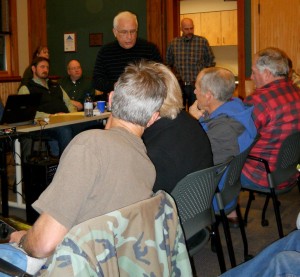
That is not a meeting intended for community education. That is a meeting intended for EXCO to arrange potential leases to be negotiated and even signed.
In a public building, advertised as a public educational event. Is this an acceptable tax-payer paid use of a public building and public resources? Is it fair to say that such a use commits at least an impropriety-a lease signing meeting for a few landholders advertised as a public meeting for a community?
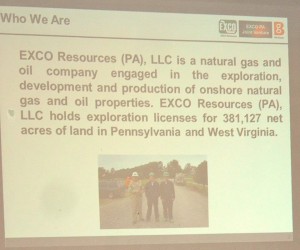
That the language of the MDN includes a reference to “lessors” is not a solicitation to procure a lease. “Lessors” means “already leased.” Those folks don’t need landmen. So why five landmen picked out and identified to the audience?

Why a lease negotiations representative?

Why attorneys?

Why a public relations representative fake-educational front man?

Why the CEO of EXCO, Douglas Miller?

The EXCO attorney was clearly not comfortable with photographs or filming. Indeed, she insisted that no filming be undertaken. But this was a public “community” meeting in a state forestry-DCNR-building. What didn’t she want us to photograph/film?
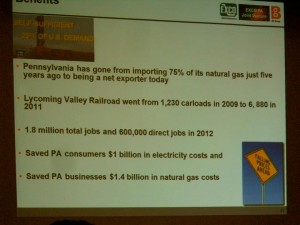
The question period was civil-but quite contentious. The EXCO representatives also appeared to have been caught quite off-guard by the well-informed questions posed to them by audience members.

Indeed, a number of audience members left during this portion, and some of these seemed put-out.

Could they have realized how wholly misled they had been by the landmen once we-the anti-fracking activists- began to lay out the case for EXCO’s environmental, administrative, and health-endangering violations?
Did they not want to hear about the DEP/EPA fines EXCO has paid within the last year of operations in Pennsylvania?
The Progress News: EPA enters into agreement with EXCO Resources
Were they disturbed when someone pointed out the fact that, once you do the basic math, the “.05” EXCO claims is the amount of chemical solution (they called it “dish detergent”), amounts to hundreds of thousands of gallons of carcinogens, surfactants, and biocides for the millions and millions of gallons (they acknowledged five million as average) they use to frack a single well?
04/12/2012: EXCO Resources to Pay Penalty for Safe Drinking Water Act Violations in Clearfield County, Pa.
Were they taken aback by EXCO’s demonstrably false claim (see links in comments below) that they recycle “100%” os their waste water-when in fact they operate deep injection wells?
EXCO Resources pays DEP fine - SunGazette.com | News, Sports, Jobs, Community Information - Williamsport-Sun Gazette
Burning Question: Where Are Pa.’s Deep Injection Wells? | StateImpact Pennsylvania
Did they wince at the point made that FracFocus reveals only those chemicals used in fracking that are not protected by EXCO’s proprietary property “rights’?
Hydraulic fracturing: FracFocus can’t replace full, public disclosure, groups say — 05/21/2012 — www.eenews.net
Did they wince some more when ACT 13 was laid out as the complete industry-favoring sham that it is?
Did the recoil at the revelation that EXCO will abandon its waste water disposal wells once its bonds expire, and once any regulatory agency isn’t paying attention?
Did some folks in that audience have to face the unpleasant discovery that they’ve leased their land to genocidal profiteers?
Perhaps. Don’t know. Seems Plausible. No excuse for ignorance. Best run home and watch Wheel of Fortune ’til the checks come in.
UPDATE: BELOW IS A COPY OF MY CORRESPONDENCE WITH JOHN SILLA-ORCHESTRATOR OF THIS FAKE COMMUNITY MEETING. IT’S LONG, BUT I HAVE COPIED IT IN FULL SO THAT THE READER CAN SEE IN JUST WHAT THIS MANIPULATION AND ABUSE OF THE PUBLIC TRUST CONSISTS. IN LIGHT OF WHAT JUST HAPPENED IN MONTROSE, WE DO NOT WANT TO BELIEVE THAT THE LUXURY OF HAVING MEETINGS IS NECESSARILY ANY GUARANTEE OF INDUSTRY TRANSPARENCE-OR THE RESPECT OF A CITIZENRY BY ITS GOVERNMENT. IN FRACKLAND, NOTHING COULD BE FURTHER FROM THE TRUTH.
PLEASE READ FROM TOP TO BOTTOM.
JOHN SILLA:
From: JOHN SILLA [[email protected]]
> Sent: Wednesday, January 09, 2013 4:46 PM
> Subject: FRAC FOCUS CHEMICALS
>
> After the meeting last night, I clicked on FRACFOCUS.com today , and there is a lot of information on the site about
> chemicals, their purpose, and the consequences for not using. This site is partially sponsored by the CLEAN WATER PROTECTION COUNCIL.
> According to the new Act 13 all operators must input this information after the well is fraced.
>
> There is specific information by well site and in order to get this information on the website, go to the top of the first page where
> it has find a well by state, and fill out the information. You will need the API number which is the permit # .
> So since we were talking about the Marquardt well, I typed in the API number 37-113-20025 which is also the permit NR.
>
> It lists all the chemicals used in the fracing cocktail, including percentages and volume.
> It also lists trade secrets by ingredients and volume and percentages; trade secrets are protected by Federal Law (see bottom of page 2).
>
> At the well site, there is job safety officer who keeps Material Description sheets
> and these sheets list the descriptions for the trade secrets should a need arise to provide information to a physician (per Act13).
>
> The information is pretty consistent with what we were told last night by the EXCO people.
> You can see that 83.51 % of the cocktail is water (3,732,873 gal.) and 16.06% is silica sand. Adding that together = 99.58% of the frac
> fluid is sand and water which totals approx. 4,330,280 gallons pumped into the well to a depth of 9320 feet.
> So the remaining difference = .43% chemicals. which is .0043 x 4,330,280 = approximately
> 18,000 gal. of chemicals used for fracing in this particular well .
>
> EXCO told us they extract 100% of the flow back, so apparently the cocktail is reused many times.
************************
WENDY LYNNE LEE:
On 1/9/2013 5:20 PM, Lee, Wendy L wrote:
> Here’s the serious problem, John. The industry uses FracFocus effectively as a substitute for the state’s regulatory rresponsibility with respect to frack-chemical disclosure. Moreover, submissions to FF are voluntary-and we all know the DEP does not do its job with respect to demanding full disclosure or full reporting of data. Consider what’s in fact from Energy in Depth about Frac focus:
>
> “Myth: In a July, 2012 report, the Natural Resources Defense Council criticized the use of FracFocus to satisfy state disclosure requirements. Though many states and drillers are using FracFocus, the report said, the site lacks any way for companies to record much of the information required by some states. [NOTE: the NRDC report can be found here]
>
> Fact: FracFocus was never intended to contain ALL of the information related to a fracture job or well treatment. It is a “chemical disclosure system”. Many of the elements referred to by NRDC are, and have been, collected on state well completion reports for many years . Collecting them again in FracFocus would be redundant and inefficient.
>
> Myth: “Because the information provided by FracFocus is so limited, there is not a single state in which disclosures on the site contain all information required by the state rule,” NRDC wrote.
>
> Fact: This is simply not true. If the FracFocus system did not contain all of the information required by a state’s rule on chemical disclosure, the state could not use it for their regulatory reporting, yet eleven states already do so and nine more are in the process of adopting it. FracFocus contains ALL of the information required by these states with respect to “hydraulic fracturing chemical disclosure”. It will also continue to evolve as state’s needs change.
>
> Myth: Some environmental groups have been disturbed to see FracFocus becoming a substitute for traditional regulatory disclosure. They say the registry limits its usefulness in a way that provides less transparency and accountability than standard government disclosure.
>
> Fact: Because FracFocus allows any individual to go to a single website to obtain chemical disclosure information, rather than having to request the information directly from state agencies on an individual state by state basis, it increases access to the information. Further, the idea that it is somehow less transparent than standard government disclosure is inaccurate. Most states do not require electronic reporting so the fact that FracFocus provides information on a well by well basis is nearly identical to the “standard” way in which states would provide the information based on an “open records” request.”
>
> In other words, FF is only AS reliable as have been previous state registries, and there is NO guarantee that these have been reliable. Indeed, there are many reasons to think they are not-especially in the big gas states like Texas and Pennsylvania.
>
> And there are other serious problems.
>
> Consider:
>
> “Open-government and environmental groups are disturbed to see the hydraulic fracturing registry FracFocus.org becoming a substitute for traditional regulatory disclosure, saying the site limits its usefulness in a way that provides less transparency and accountability than standard government disclosure.
>
> The website’s terms of use forbid the kind of broad use of the chemical information needed to cross-reference it against other data. And presenting it well by well in PDF format, rather than a spreadsheet or database, they say, locks up the data and blocks in-depth analysis.
>
> The organization that runs the site, the Ground Water Protection Council, says it was never designed to be a “national environmental analytic tool.”
>
> But state governments have been adopting it. The Obama administration is considering adopting it for disclosure on public lands even though the administration’s advisory panel on hydraulic fracturing faulted the site for not making the data more easily accessible.
>
> “It should be reported on a well-by-well basis and posted on a publicly available website that includes tools for searching and aggregating data by chemical, well, by company, and by geography,” the panel stated in its August report.
>
> FracFocus does not have such tools for aggregating, and it’s not planning to add them.
>
> “I realize there are folks who want to be able to do all sort of comparative analysis, but that is not what this site was originally intended to do,” Mike Paque, executive director of the Ground Water Protection Council, wrote in an email exchange with EnergyWire. “We did not set out to build a national environmental analytic tool or website, which some seem to think FracFocus should be. I guess no good deed goes unpunished.”
>
> New laws in Colorado, Texas and Pennsylvania allow drillers to satisfy their disclosure requirements by posting to FracFocus. At the urging of Exxon Mobil Corp., the conservative American Legislative Exchange Council adopted the Texas law as model legislation. Now it’s moving through the Illinois Legislature (EnergyWire, May 2).
>
> In Washington, the Obama administration says it’s working with GWPC to see whether the disclosure it plans to require for drilling on public land can be integrated into FracFocus (Greenwire, May 4). Oil and gas companies are lobbying the White House to allow that (EnergyWire, May 7).
>
> Critics say FracFocus shouldn’t serve as a substitute for true “public” disclosure.
>
> “FracFocus.org is not a website that is useful to the public, as information made available through a state government or multistate website would be,” said Joshua Ruschhaupt, director of the Sierra Club’s Rocky Mountain Chapter. “We do have a problem with state governments requiring disclosed data and critical information to be provided only through a site with massive restrictions on its use.”
>
> ‘Searchable,’ not ‘aggregatable’
>
> Earlier this month, EnergyWire asked GWPC for the full database of ingredients. The organization declined to provide it.
>
> “We cannot release the database as a whole,” said Mike Nickolaus, GWPC’s special projects director. “It is a policy decision that was made early on in the development process.”
>
> Some, however, have already started finding their way around the obstacles put up by the site. Julian Todd, a programmer who co-founded a British company called ScraperWiki, has “scraped” some of the data from the PDFs and put it in a format downloadable to a spreadsheet (to see it, click here). Because of the difficulty of extracting the data, he has been able to get chemical information for only about 2,000 of the 17,000 wells listed.
>
> On FracFocus, wells can be searched by operator, state and county. But because the site is not aggregatable, the results cannot be organized into a chart. Instead, there is an individual PDF for each of the roughly 17,000 wells.
>
> So, for example, one could search for all the Chesapeake Energy Corp. wells in Bradford County, Pa. That returns more than 140 PDFs spread across eight screens. To make a chart of all the chemicals used, a researcher would have to open each one and copy the list.
>
> To use FracFocus, companies submit their information to the site after a fracture treatment, or “frack job,” using a spreadsheet template. If the data were presented that way, it could be easily aggregated and cross-referenced with other information, like water pollution data.
>
> Instead, the spreadsheet is destroyed after the information is converted to a PDF, under the agreement that GWPC and the Interstate Oil and Gas Compact Commission (IOGCC) reached with drilling companies when the registry was created.
>
> Opening, recording and analyzing the contents of those 17,000 PDFs wouldn’t just be tedious, it might be illegal. It appears to be against the site’s terms of use.
>
> “Except for a single copy made for personal use only, you may not copy, reproduce, modify, republish, upload, post, transmit, or distribute any documents or information from this site in any form or by any means without prior written permission,” the terms state. Unauthorized use, it states, “could result in criminal or civil penalties.”
>
> It’s not clear how aggressively this might be enforced, however. The ban appears to be part of an off-the-shelf, boilerplate set of rules, which also prohibit seemingly irrelevant uses of the information, such as gambling.
>
> States can and do present other information, such as oil and gas production data, in spreadsheet form.
>
> But the oil and gas industry opposes making the fracking data available in such spreadsheet format for fear that drilling opponents might misinterpret it. Lee Fuller, head of the industry group Energy in Depth, notes that opponents would likely use such data to take certain toxic chemicals and add up how much was used in a state or across the country.
>
> “The reason that industry is concerned about it is that these numbers are not really meaningful, but they’re used to create anxiety in communities,” Fuller said. “It would be used for political purposes.”
>
> Paque said concerns about misinterpretation did not drive design of the site.
>
> “That is not a concern of ours,” Paque said. “Any data can be misinterpreted at any time, and the opportunity to do so with FracFocus already exists.”
>
> To environmental groups, the obstacles to broad use of the data indicate the site is designed to serve the industry’s interest rather than the public’s.
>
> “It’s known that industry had a strong role in the group that set up FracFocus,” said Michael Chiropolos, chief counsel of Boulder, Colo.-based Western Resource Advocates, “and there’s a suspicion that it was set up more to protect industry than to establish transparency.”
>
> FracFocus was created by GWPC and the IOGCC with praise from industry and federal funding from the Department of Energy. The two groups, Oklahoma City-based organizations of state officials with ties to industry, now run it.
>
> GWPC is a private nonprofit whose governing board is composed of state water regulators, but it has accepted industry funding, including $47,500 from the American Petroleum Institute in 2009. The IOGCC describes itself as a “multistate government agency,” though it has oil and gas executives on its governing board and its meetings have industry sponsors such as BP PLC, Exxon Mobil and Royal Dutch Shell PLC.
>
> Private concerns
>
> Critics say public data shouldn’t be entrusted to a private entity like GWPC.
>
> “If this information needs to be disclosed, it needs to be usable by everybody, not locked away in PDFs,” said Tom Lee of the Sunlight Foundation, which advocates for greater government openness and transparency.
>
> The Sierra Club’s Ruschhaupt added that “obtaining permission” to use public information contradicts the definition of “public information.”
>
> GWPC and IOGCC launched the site in April 2011 as a way for oil and gas drilling companies to voluntarily disclose the chemicals they inject underground during drilling as part of the fracturing process.
>
> As the shale boom began, drillers fought Democratic legislation calling for disclosure and federal regulation of fracturing. Industry argued that full disclosure to the public meant giving away trade secrets. When the calls continued into the realm of shareholder resolutions, industry argued that there already was disclosure because Material Safety Data Sheets were posted at well sites, and state regulators could demand more detailed lists.
>
> Then, a few companies and states started putting lists of commonly used chemicals on their sites (Greenwire, June 21, 2010). When critics called that too vague, officials started working on FracFocus.
>
> It has become industry’s preferred means of satisfying government-mandated disclosure, by both states and the federal government.
>
> GWPC’s Paque said the site is being updated because of demands from states using it for mandatory disclosure. Paque calls it “FracFocus 2.0,” and it will allow searches by date, chemical name and chemical identification number. The site can already be searched by company, state and county. It will not become aggregatable.
>
> “We are trying to do something right with FracFocus,” he said, “and put information out for landowners and the general public that did not exist two years ago.””
>
> http://eenews.net/public/
>
> In other words, FF may be well-intended, but it is NO substitute for state-enforcible regulation of chemical disclosure. Moreover, it says pretty much nothing about those chemicals protected by proprietary property rights-and that vacuum is significant.
>
> So, NO, FF is not remotely adequate. It is the fig leaf the industry uses to EVADE state regulation.
>
> The EXCO presentation was deliberately vague, short on facts, and long on promises of transparency without any of the substance. Moreover, there’s something quite odd about a meeting advertised (and it was advertised-Marcellus Drilling News) as a “community” meeting-when it was really an orchestrated opportunity for un-leased potential lessors to sign up with EXCO. The public representation of the meeting does not square with what it was actually for.
>
> Wendy Lynne Lee
**************************
JOHN SILLA:
From: JOHN SILLA [[email protected]]
Sent: Wednesday, January 09, 2013 8:43 PM
To: Lee, Wendy L
Subject: Re: FRAC FOCUS CHEMICALS
Did you type all this, very impressive, you are a very bright lady - but
I have to tell you, MDN had no influence on this meeting, it was
strictly between the TF here and EXCO.
this may have been advertised in the local County newspaper (by accident).
No, there was no alternative motive to setting up the meeting other than
transparency, how do I know, because
I was personally involved in setting up the meeting. But, even if EXCO
wanted to make contacts, so what?
They are in it to make a profit. (which is getting more difficult to do).
And I can tell you they made at least one contact and I overheard the
conversation and it went something like “at a future
date we may be interested”, so it was not a hard sell.
The purpose of the meeting was:
a. Transparency between the general public and EXCO,
b . Transparency between lessors and exco
REMEMBER - EXCO could have declined to put on the mtg.
And it was not their first, so they knew what to expect.
It was stated at the meeting last night that it is required by ACT 13
that the operators use FRACFOCUS to input their fracturing information.
I called our local EM squad for some information and was told that the
MSDS sheets at the well site are still being maintained
and list all the chemicals and amounts used, so this is probably the
government reports.
My opinion is that FRACFOCUS is intended to answer the transparency
issue and is designed for use by citizens
not that many will use it, because you saw only a few people raise their
hands last night when I asked who used it.
It’s a beginning, a start. Sometimes you gotta trust people to know
what they are doing and want to do the right thing.
Like when you board an airplane and expect a safe landing.
Thanks for your input. best wishes.
**************************
WENDY LYNNE LEE:
Dear Mr. Silla,
First, a correction: Of course, I did not type this. Computers afford this luxury called “cut and paste,” and apparently you did not read it carefully, or you would have seen clearly that (a) I used quotation marks, and (b) I site my sources. In this case EID in the first case, and in the second Energy Wire.
Second, I did not claim that MDN had influence over the meeting. I claimed (and rightly) that MDM announced the meeting-and they did-as a public “community” meeting-which it was in fact not. It was an “invite” to prospective lessors meeting advertised as “community” in order to “justify” the use of PUBLIC space paid for by PUBLIC tax dollars. THAT is the impropriety. The public notice in sources like MDM was simply cover for what was an opportunity for EXCO to woo prospective lessors.
THAT is why the EXCO people numbered at least 20 persons in the room.
That is why a number of EXCO landmen were present.
That is why the EXCO CEO and lawyer bothered to come out.
A “community” meeting in no way required all that.
And that is why EXCO didn’t want any filming and was made very uncomfortable by the photographs-this wasn’t a real public meeting. That was simply the sham to procure use of the space so that EXCO could negotiate leases for more drilling.
Moreover, you effectively admit this when you point out that if the announcement of the meeting was in some local paper it was an “accident.” It was an “accident” because it wasn’t a public meeting. Clearly, there was, to use your words, an “alternative motive.”
The “so what” is that this is FALSE advertising. The use of this public space as a market for EXCO is an abuse of that space-an abuse magnified by the fact that the meeting was NOT represented by you or by EXCO as such. That you were “personally involved” only magnifies the issue further because you effectively acknowledge that YOU were involved in false advertising.
Whether there were “hard sells” or not is irrelevant. That merely speaks to the point that greed continues to overshadow moral and environmental responsibility.
The purpose of the meeting absolutely was not “transparence.” Had it been, EXCO would have been transparent, and this was in no way the case. Speaking in the glittering generalities of a slide show that promotes a process as manifestly hazardous to the environment and to human and nonhuman health does not constitute “transparency.” The transparence at that meeting was introduced by audience members with the tenacity to make public the record of violations, well failures, and inconsistencies (especially about waste disposal). A number of people also got up and left once the pretense to transparency was exposed for the sham that it was. I made it a point to photograph the empty and emptying seats.
That EXCO could have declined the meeting is also entirely irrelevant-you’re effectively admitting here that they could just mow us over without public input at all. But what you fail to see is that a sham meeting dominated by sham transparence amounts to the same thing. By lulling us into thinking EXCO actually cares about the environment and human health, folks are (a) more likely to sign over their great grandfather’s land to this gutting of it, and (b) won’t keep asking for meetings. As you acknowledge yourself, EXCO “is in it to make a profit.” Indeed they are-and if you think such meetings are about anything other than that mercenary objective, you have been swindled by your own invested interests.
Now to FracFocus:
1. That FracFocus is required by Act 13 is nothing other than a capitulation of a woefully corrupted state government to an entirely voluntary registry effectively controlled by the gas industry. We have no reason whatever to trust that it is complete, timely, or accurate. Moreover, it does NOT include chemicals protected by proprietary rights, and-as is laid out in the information I copied here-it is unwieldy and hence uninformative for a non-chemist to use.
2. What FracFocus provides is a false sense of security for those who’d consult it. It allows us to think we enjoy a transparency we do not enjoy at all. FracFocus is just like this meeting-a performance intended to charm us into a false sense of safety and the resultant complacency while the gas industry reaps huge profits at the expense of industrializing Pennsylvania, and destroying the state’s water and air.
Lastly, to “Sometimes you gotta trust people to know what they are doing and want to do the right thing.” It’s actually hard to know what to say to this. You could just as well be a cigarette manufacturer in front of a congressional hearing denying that smoking causes cancer. No, Mr. Silla-THIS is the extraction industry. Their history is fraught with grotesque failures to protect the public health. Their industry is rife with schemes to acquire public and private lands. Theirs is a history that IS the coal industry, that IS the BP disaster in the Gulf, that IS the 29 dead miners in West Virginia, that IS the endless burning of coal seams in Centralia, that IS the EXXON Valdez, that is Dimock, that is the silicosis of silver mining in the Andes. Fracking, mountain top removal, and tar sand extraction are simply the last avarice-driven gambits of an industry whose wealth depends on a dwindling resource.
To invest trust in THIS industry is like offering the cannibal from Silence of the Lambs the key to his prison cell.
A comparison that’s over the top?
Hardly. Australia just added a new color to represent the increase in the country’s Summer temperature: 123 degrees.
Wendy Lynne Lee
*******************************
Want to see who the EXCO CEO, Douglas Miller really is?
See: Failure Has Its Rewards: Exco CEO Gets $3.3 Million - Deal Journal - WSJ


Great report. How fracking stupid do these frack flaks think people are ?
No one fights for democracy more eloquently… thank you, Wendy.
Wendy, way to write an unbiased piece?
HI Chest-I’m not sure what your point is….care to elaborate?
I stumbled on you sites after a Google search for anti/pro fracking blogs, just trying to find one site that gives strait facts for both sides of the issue. I guess blogs can be as one sided as the moderator wants since it’s not real journalism. I did note something that could be corrected in the “basic math” on the 5 million gallons and the 0.05% of chemicals as you noted it to be “Hundreds of Thousands of gallons of carcinogens…” When multiplying by a percentage you fist need to divide the percentage by 100. ex. 0.05% x 100 you get 0.005 or you can just move the decimal two places to the left. Then you can multiple it by the total amount of water say 5,000,000 gal and you get 2,500 gal. vs’ hundreds of thousands of gallons. Sorry to point it out but I was a math major and it stuck in my mind. Do you know of any upcoming meeting like the one you attended, I have the thought that since these are public I could attend to see for myself what these community meetings are all about.
Chest R
You were a math major. Really ? Where ? You weren’t an English major:
“. . . you fist need to divide. . .” ?
The percent of chemicals varies, but 1/2 of 1% is not uncommon, which is .5%, not .05%, so 5M gal. x .005 = 25,000 gallons, or several tanker truck loads full of undisclosed chemicals, some of which may be carcinogens.
See you at the next meeting, “Chest R.”
HI Chest,
Thanks for your observations. I appreciate your commitment to getting the math right-this is very important. My reference, however, to thousands of gallons of chemicals is not intended to be about any single fracking operation, but the thousands of fracking operations over a period of time. If Pennsylvania does see the some 200,000 projected wells to 2016, this will indeed amount to thousands of gallons-all of it carcinogenic or toxic in some other fashion. And of course, the serious issues are not confined to the wells. There are similarly serious issues concerning emissions from compressor and dehydrator stations, pipeline leaks, and so on. When a corporation uses the word “recycling” they are plainly lying. The DO “clean” that “re-frack water, and they DO re-chemicalize it, and eventually it DOES have to be disposed of, and that will involve a deep injection well-also a site of serious possible hazard. This water cannot ever be returned to the water table, and it’s also not just about the amount of toxin in it-it’s about its interactions with other toxins, the type of toxin it is (benzene, for example is highly carcinogenic in relatively small quantities).
As for meetings, my FB page is a public access page, and I post quite a bit of meeting, event, etc, information there.
raspberry ketone says
Remarkable! Its truly awesome piece of writing, I have got much clear idea concerning from this paragraph.
It is the best time to make a few plans for the long run and it is time to be happy.
I’ve read this put up and if I may just I want to suggest you few attention-grabbing things or tips. Perhaps you could write subsequent articles referring to this article. I want to learn more issues approximately it!