


Not surprisingly, the Environmental Defense Fraud’s work is simply a replay of the same stunt pulled by frackademics at Penn Stat and MIT. Wherein they determine that new wells cherry picked by the industry do not leak. When new. This is not news, much less worthy of peer-reviewed study, just an exercise greenwashing. Since it neatly dodges the real issue - methane leakage from aging wells and aging infrastructure - right to the burner tip.
Read the study - here - but long story short, they sniffed some fittings and valves on new wells that the industry allowed them to test and determined they weren’t leaking. What a surprise. Remarkably, they only tested the ambient air downwind of twenty (20) producing well sites hand-picked by the industry. No ages given on the wells, but if they are shale producers, probably less than 5 years old. Which is not representative of leakage at thousands of aging US gas fields. Those 20 well sites were a subset of all the well sites proposed by industry - and picked and tested by the researchers, so they were doubly cherry-picked - Maraschino cherries. Here it is in black and white from page S -56 in the appendix:
“Emission fluxes from natural gas production sites
Measurements were made downwind of a total of 20 production sites. Results are
summarized in Table S4-5. Table S4-5 lists the number of wells per site, the emissions from
various pieces of equipment on each site, the total emissions from the site based on direct source
measurements and emission estimation methods, and the total site emissions based on downwind
measurements.”
That’s it. Out of hundreds of well sites that the industry allowed the researchers to test, they only measured atmospheric emissions at 20 of them. And there is no information given on the age of the wells, their condition, etc. The rest of the researchers work, indeed the bulk of it, consisted of sniffing flanges at individual wells to see if they were leaking. Since most of these were new wells, that’s a bit like testing new cars to see if they are leaking oil. The fact that most are not is not indicative of their life-cycle leak rate. It only means they don’t leak when new.
“There are lies, damn lies, statistics, and then there are Frackademics.”
The rest of the study consisted of putting sniffers on “best practice” valves and testing new producing well flowbacks and some work overs - under the watchful eye of the industry and EDF’s colleagues, such as URS, who has been involved in similar misleading studies. All wells tested were Potemkin Wells hand-picked by the industry, and most of them were new wells - no aging leakers. Meaning their sampling is not representative of the average age and average condition of the US gas well population. Not surprisingly, they came up with numbers that are far less than any previous study.
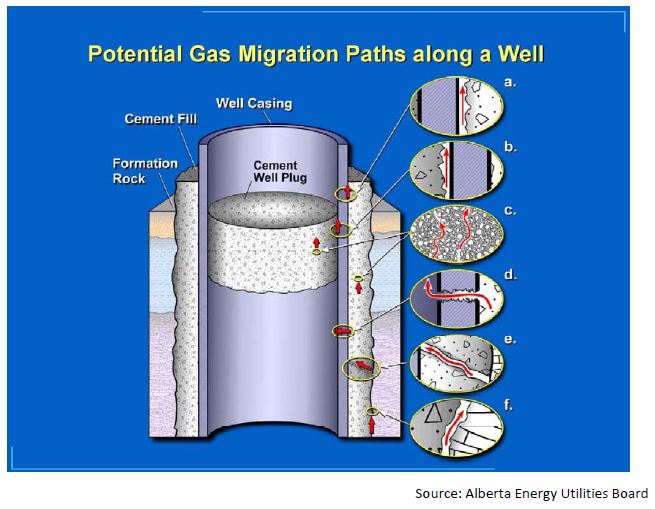
Shale gas wells leak as a function of time - they typically do not start leaking until after the 2nd year, so this study does not address the fundamental problem of methane leakage from aging infrastructure, aging well bores and the “worst practices” realities of fully developed gas fields.
Testing new wells is a standard industry gambit - indeed that is exactly what Penn State did a year ago, they used a small sample size of new wells that are not representative of the Pennsylvania gas well population - much less the US gas well population, then extrapolated those results - as if they were indicative of the larger population. The PSU study purposely excluded wells that they knew had problems.
http://www.scribd.com/doc/71819754/Water-Contamination-From-Gas-Drilling
Not surprisingly, when it was MIT’s turn, their Frackademics pulled the same stunt: they only tested shiny new wells - given them by industry to confirm that most shiny new gas wells don’t leak. Which is not in dispute. The MIT study limited itself to wells that were less than 10 days old. This tidy bit of gaseous greenwashing earned Moniz an appointment as Obama’s Energy Secretary.
http://www.nofrackingway.us/2012/12/03/mit-frackademics/
EDF apparently uses the same ploy - using new Potemkin wells as proxies for the aging US gas well population. And yet, even after the PSU and MIT study used the same trick, the press reports this as if it is representative of tens of thousands of aging American gas wells. Au contraire. It is simply frackademics pulling the same stunt.
Geological conditions for well bore leakage vary, some areas are more prone to produce fugitive emissions - few of the 20 well sites tested were in the more problematic areas- such as the Marcellus in Pennsylvania.
Obviously the way to test gas leakage is over an entire mature producing gas field - consisting of wells and infrastructure that are representative of the age and condition of most US gas fields - and which could have leaks in the gathering lines, compressors, gas processing plants, flaring and venting - as well as at the well head. That would be more indicative of the US gas field universe. Fortunately, such atmospheric tests have been done, finding overall leakage rates of 9 to 12%.
http://www.nofrackingway.us/2013/08/06/12-methane-leak-rate-in-shale-gas-field/
Dr. Ingraffea and Dr. Howarth have already commented on the flawed EDF approach. The EDF are going to present their findings in NYC on Sept. 30th. Someone might ask them what the average age was of the wells tested for ambient air leakage. If, on average, less than 5 years old, then this study is clearly not representative of the US gas well inventory - it is little more than a cherry picked con job - since the majority of gas well bores drilled in the United States are more than 5 years old. And sooner or later - they all will leak. Really just a matter of how much, how soon.
“Please join the Center on Global Energy Policy for a presentation by Steve Hamburg (Chief Scientist) and Mark Brownstein (Associate Vice President & Chief Counsel, US Climate and Energy Program) of the Environmental Defense Fund (EDF). Hamburg and Brownstein will present the findings of a groundbreaking new study (PDF), published in the Proceedings of the National Academy of Sciences, that examines sources of methane emissions from shale gas production sites across the U.S. The study, conducted by scientists at UT-Austin and executed in close collaboration with nine oil and gas companies and EDF, finds — among other things — that natural gas sites release 0.42 percent of methane produced. This finding is in line with EPA’s current emission inventory estimate for the production segment of the supply chain, though the study also found emissions from specific phases of production are likely to be higher or lower than EPA estimates. Hamburg and Brownstein will discuss the study’s findings and methodology as well as its implications for shale gas policy and the role of natural gas in our energy future. A moderated discussion will follow. Registration is required. This event is open to the press. EDF’s factsheet on the UT-Austin study is available here.”
{ 2 comments… read them below or add one }
Hopefully, they take your suggestion, Chip. Study wells 5 years and older and see what results you get and in the Marcellus and then compare with this present study …..
I wonder what the URS environmental consultants on the NYSDEC dSGEIS think about the URS environmental consultants on the EDF study. Actually, I’m not really that interested.
{ 2 trackbacks }