



Mike Bernhard sent out some thought-provoking comments on how a blanket moratorium extension on all drilling (if one even got out of committee in the state senate) might cloud the picture of force majeure claims in New York - since the extension bill would expand the moratorium to include vertical low permeability formations - probably because the only way to economically produce such wells would be to frack them horizontally, so a vertical shale well would in all likelihood be a test well for a horizontal completion. So a vertical test for a horizontal completion would be a worthwhile subject for state scrutiny - because it is a precursor to a horizontal well. . . .
The controlling case in such claims, Aukema, is based largely on the fact that the operator, Chesapeake, did not drill any well to hold the lease, they just claimed they could not drill a horizontal well - due to the state’s de facto moratorium on horizontal well permits. So the fact that they cannot drill horizontal wells, or even vertical shale test wells - if such drilling is under state review - should not trigger force majeure. The Aukema Federal court decision holds and you can get out of a lease if force majeure is being wrongly claimed - including leases that some bankrupt Norwegian penny stock scam won’t let you out of.
Leases are commonly “held by production” (HBP), meaning as long as they are producing, the lease stays in effect. Leases that are not drilled during their primary term invariably lapse - anywhere but New York . . . Chesapeake knew that, but tried to claim that it could not drill a well. Any well.
Aukema assumed that the operator could drill vertical wells. If the moratorium extension were to preclude all vertical wells, then the force majeure argument would be a matter of first impression for a New York court. Since the drilling of any vertical wells has not been precluded. So Mike’s scenario is a bit hypothetical on multiple levels, but a good thought provoker:
Here’s Mike’s take, with my comments in bold:
“The Southern Tier is the part of New York most likely to be subject to drilling using high-volume hydrofracking (HVHF), whether on the basis of the completion of the SGEIS, the promulgation of new regulations or the initiation of an “experimental” drilling program.
The primary term for most leases in the Southern Tier has already expired, or will soon expire. The gas companies operating in the Southern Tier obtained most of their leases in 2006–2007. While the language of these leases differed from company to company, most leases had a primary term of five years and established several circumstances under which the lease term would be extended beyond five years from the date of execution:
1. The commencement of drilling activity before the end of the primary term
2. The production of gas before the end of the primary term
3. By tendering a per-acre payment (sometimes not stipulated) before the end of the primary term, that term can be extended a further five years, and by the same means extended a further five years after that
4. An application for a drilling permit is pending with the DEC
5. A force majeure (an act of god) preventing the company from drilling
The first three ways (above) in which the gas companies can extend their leases all cost real money. In the current economic climate, and especially given the low price of gas, the companies would prefer the last two options, whose cost to them is trivial. The fee for a permit application that will hold open the leases in a one-square-mile drilling unit established by the application is around $4,0001. Declaring a force majeure that applies to an entire leasehold is even cheaper. Both of these cheap options are being used by drillers.
Some drillers can extend their leases by submitting applications for permits.
Despite the executive action launched by Governor Paterson and continued by Governor Cuomo, the current moratorium on the permitting of HVHF wells does not prevent some drillers from extending their leases by submitting applications for permits.2 In fact, the longer the permit moratorium is in place, the longer those applications are pending, the easier it is for drillers to “sit on” their leases and wait out current low prices and lack of export infrastructure.
If the lease terms indicate the primary term can be extended by filing a permit on a well that is not subject to the moratorium, then the lease can be extended by filling such a permit. But this was not the case in Aukema.
The state agrees that its own SGEIS process constitutes a force majeure.
The state made no such stipulation, they just cut a deal with Chesapeake. The AG’s deal with Chesapeake is not law - it’s a settlement (there’s a difference) The controlling law is the Aukema decision - which invalidates the force majeure claim as currently argued.
The cheapest way to extend the term of the cheap leases bought during the “land rush” period is to declare a force majeure. Chesapeake Energy, for instance, has told its lessors that “During the time that your Lease is extended on the grounds of force majeure arising out of the SGEIS process . . . [our] interest in your Lease shall not terminate until December 31, 2013 . . . in accordance with the AOD (Assurance of Discontinuance).” The AOD was an agreement by Attorney General Schneiderman to end his investigation of Chesapeake’s assertion of force majeure against its lessors.3,4 Thus, Chesapeake’s leases were, for the most part, extended to the end of 2013, regardless of when they were signed.4 There was no agreement as to whether Chesapeake’s force majeure claims, based on the state regulatory process, were valid or invalid.
No automatic extension of Chesapeake’s leases to year end. Per Joe Heath of Fleased:
“Chesapeake’s expired leases have NOT been extended until the end of this year, as stated in the last sentence on the fist page. Chesapeake hasclaimed that in the fraudulent, registered letters they mailed to their-2-leaseholders from November of 2012 to this April, but this claim is fraudulentand I have been able to get the company to send a Release for every lease Ihave challenged them on. So, if folks know of Chesapeake lease holders who receive this registered letter, have them contact me with the letters andtheir leases.”
The state does not enforce the Aukema decision on other drillers.
What the state AG does or does not do regarding Aukema is not relevant to its validity as a precedent - for any landowner to use in a force majeure action. The AG is a politician, Aukema is a court ruling. Sometime’s there’s a difference. For a precedent to be applied - it must be claimed as a precedent in a lawsuit.
http://www.scribd.com/doc/113409103/Aukema-Decision-101512
Subsequent to the AOD between the AG and Chesapeake, a federal court decision in the Aukema case5 declared that the existing moratorium, during which the SEQRA–mandated SGEIS process was playing out, could not be used as a force majeure to extend leases because the drillers could always use vertical drilling, or drill in other formations, to make use of their leases. However, the AG’s office considers the ruling to apply narrowly to the parties in that case, and is not taking any action against force majeure extensions of other leases.
Because the current moratorium legislation would, for the first time, extend the governor’s moratorium to cover vertical drilling, it gives the drillers an opportunity to “re-try” their force majeure claims.
If the driller is precluded from any operations that would extend the lease by performance - including drilling any vertical well, then they would have a new argument. If the moratorium extension only applies to HVHF wells and vertical shale (low permeability formation) wells, then Aukema would probably control - since the state was acting within their right: The only reason for a vertical shale well is a test for a horizontally fracked shale well.
A new, legislated moratorium may extend leases in the Southern Tier.
People had hoped that Aukema had extinguished force majeure claims, but the AG’s narrow reading of Aukema (applying only to the parties named in the suit) has undermined that hope.
Not really, it just means the AG is content with their Chesapeake settlement. Other landowners are free to argue Aukema to get out of dud leases - if the facts of their complaint is similar to the plaintiffs’ in Aukema.
The value of Aukema as precedent would be further undermined by the current moratorium legislation because it suspends vertical drilling in shales: extending this moratorium may well give rise to new force majeure claims. A new lawsuit defending against those claims may land in a court more receptive to force majeure claims than the one that produced the Aukema decision.
If the circumstances are the same as Aukema, then it would control as a precedent.
Drillers claimed in Aukema that only HVHF is profitable for shale drilling. In fact, of the 36 applications for drilling shales made in the last 30 months, only two applications for vertical drilling remain in the queue. Thus the language suspending the issuance of permits for vertical drilling offers little protection, even in the short term, but can give rise to new force majeure claims whose disposition is entirely uncertain.”
Per Joe Heath: I have reviewed several hundred leases and a very small percentage of these even have this “extension by drilling permit application” provision.
A lease can lawfully be extended by drilling a well. Which was a key point in Aukema - Chesapeake never bothered to drill a well. If the operator is precluded from drilling any well, then that aspect of the force majeure claim could be a matter of first impression to a New York court. Meaning - it’s not settled. But that is not the case currently - there is no blanket moratorium - so the claims against Norse Energy are likely to follow the Aukema precedent - and the Norse leases will be tossed.
Here is Rachel Treichler’s take on the force majeure issue:
I believe it is incorrect to conclude that a moratorium on gas drilling in tight shales in New York would be grounds for extending leases under the force majeure clauses contained in the leases that I have seen.
There is no current ban on the issuance of Marcellus Shale drilling permits in New York under Article 23 of the New York State Environmental Conservation Law. If a gas drilling company wishes at this time to obtain a horizontal drilling permit in a black shale formation in New York, such as the Marcellus or the Utica shales, the company may perform a site-specific Environmental Impact Assessment under the New York State Environmental Quality Review Act. The availability of this option has been noted in several decisions of the federal district court in the Northern District of New York. See Wiser v. Enervest Operating, LLC, 803 F. Supp. 2d 109, 118 (N.D.N.Y. 2011) and Aukema v. Chesapeake Appalachia, LLC, No. 3:11-CV-00489, N.D.N.Y. Nov. 15, 2012.
The court Wiser v. Enervest declared certain oil and gas leases held by defendant-natural gas operators “null and void and no longer in effect.” The defendants had argued that Governor Paterson’s 2008 executive order constituted a de facto moratorium on drilling into the Marcellus Shale. Although the judge in Wiser decided against the defendants on other grounds, he noted in his decision that the governor’s memorandum did not prohibit the use of the conventional, low-volume hydraulic fracturing extraction method used by drillers in the region for decades and left open the option of applying to the DEC for a permit allowing horizontal drilling in the Marcellus Shale formation after conducting its own independent, site-specific Environmental Impact Statement.
The court in Aukema v. Chesapeake engaged in a much more extensive discussion of the force majeure claims and the applicable law, and determined that “force majeure whether common law or express, does not extend the leases [at issue in that case].” In reaching this conclusion, the Aukema court stated, inter alia:
“Moreover, [Governor Paterson’s 2008 executive order (the “Directive”)] does not frustrate the purpose of the leases. The purpose of the leases is to explore, drill, produce, and otherwise operate for oil and gas and their constituents. Defendants may still explore, drill, produce, and otherwise operate for oil and gas and their constituents. The Directive put a halt on horizontal drilling using HVHF; drilling permits for conventional drilling methods have, and continue to be, issued in the area of plaintiffs’ lands. The only thing defendants were unable to do during the primary terms was to horizontally drill using HVHF. The leases do not limit defendants’ right to drill to a specific type of drilling nor a particular formation. While defendants submit evidence demonstrating that horizontal drilling combined with HVHF is the only commercially viable method of production in the Marcellus Shale and drilling using conventional methods is impractical, “[m]ere impracticality . . . is not enough to excuse performance.” Phibro Energy, 720 F. Supp. at 318. Defendants did not contract for guaranteed production of oil and gas; they contracted for access, exploration, and the right to drill for a set period of time.”
For reasons similar to those set forth in the Aukema decision determining that the Executive Order currently in place for horizontal HVHF does not constitute a force majeure event that would prevent a gas drilling company exercising its rights under the leases considered by the court, I believe that if the state legislature were to enact an even broader moratorium on drilling in black shale formations, that broader moratorium would not constitute a force majeure event under the leases that I have reviewed. The leases that most New Yorkers have signed do not identify the Marcellus Shale or any other black shale formation as a target, nor are the leases limited to black shale formations. There are many gas producing formations underlying the leased properties into which gas drilling companies could obtain a permit to drill that are not black shale formations. Furthermore, as noted in the Aukema decision, exploration itself would be sufficient to extend the leases and exploration does not require a permit.
There is nothing in the terms of the unfortunate Assurance of Discontinuance (“AOD”) entered into between the New York State Office of the Attorney General (“OAG”) and Chesapeake on June 12, 2012 to change the above analysis. The AOD is strictly between the OAG and Chesapeake. The AOD is not binding on any Chesapeake leaseholder because the individual leaseholders are not parties to that agreement. Chesapeake itself is not bound by the AOD in disputes with other parties.
Force majeure issues are being litigated now by certain leased landowners in the Norse Bankruptcy proceeding. See “New York Landowners Sue Norse Energy USA Over Leases,” Katy Stech, Dow Jones Newswires, Monday, May 20, 2013,http://www.rigzone.com/news/
From The Nicole:
Like Rachel, I disagree with Mike’s view that the Sweeney moratorium bill would support a “force majeure” claim with respect to drilling leases. Mike’s post does not explain why a ban would be treated differently than a moratorium for purposes of a force majeure analysis.
The two-year moratorium on extraction from impermeable shales is reasonable to allow the State to complete a Health Impacts Analysis (HIA). Study of health impacts is a critical part of the regulatory process and should have been included in the dSGEIS from the outset. Legislative intent to require an HIA, and provide sufficient time for it to be completed, should not trigger a force majeure event any more than any of the other the revisions to the dSGEIS, which have already delayed HVHF.
The industry understood full well when the leases were signed that under existing law, regulatory study and action would be necessary to proceed on the basis of a generic EIS. The 1992 GEIS took more than a decade to finalize. In addition, while the proposed moratorium would include vertical wells in impermeable shales, it does not extend to other formations or exploratory activity and therefore a claim of total frustration of the leases (necessary for a force majeure claim) would not stand.
It is also significant that force majeure claims based on regulatory delay were rejected by the federal court in Binghamton on November 15, 2012, in the Aukema decision. This decision was issued after the settlement agreement with Chesapeake known as the “Assurance of Discontinuance” was entered. Mike’s suggestion that the NY Attorney General may apply the Aukema decision narrowly is not determinative of its precedential effect.
There are good reasons why many would prefer to see an outright ban. However, given that a ban seems politically out of reach at this time, I would strongly urge all of us to support the Sweeney/Avella two-year moratorium bill, which has already been adopted by the Assembly. It clearly has the best chance of passage given the short time remaining that the legislature will be in session. Unless the moratorium is adopted, if Governor Cuomo decides to fast track commencement of HVHF before the legislature goes back into session, this moratorium would be the only way (short of a court injunction) to stop fracking. Nicole Dillingham
Nor will an extension create a “taking” where none exists.
In an ongoing discussion, Mike Bernhard and others have opposed Senator Avella’s two-year moratorium bill on the ground that a statewide permanent ban on fracking (with criminalization) was a better long-term goal. However laudable this goal is, it is an all or nothing strategy, which carries grave risks. It should not be allowed to undercut a clear opportunity we now have to secure a two-year moratorium for the purpose of conducting a desperately needed health impacts assessment. I would not like to see us miss this chance in the hopes of securing more next session.
Mike’s stated concern about the Avella bill (that it might lead to a finding of force majuere tolling expiration of gas leases) grows out of an unnecessarily narrow reading of the Aukema decision, which held that the current defacto moratorium in New York State did not create a force majeure event in connection with expiring Norse leases. Mike worries that the Aukema decision may not apply if a legislative two-year moratorium were enacted which temporarily suspends both vertical and horizontal wells in “low permeability” shales. This concern, while worthy of consideration, should not be assumed to be sufficient to distinguish Aukema and should not be used as an argument to defeat passage of the two-year moratorium.
The fact that drilling in other formations (high permeability formations) is unaffected by the bill brings it within the holding of the Aukema decision. Additionally, satisfactory completion of the regulatory process, including a full health impacts assessment, is required by State law and was a known and foreseeable risk when the leases were entered. The industry knew that the regulatory process would take considerable time to complete. In entering leases with fixed expiration dates before the regulatory process was done, the industry assumed the risk that drilling might be restricted, severely curtailed, or even prohibited as a result of that process, and that the leases might expire unless specific actions were taken by the drillers to extend and preserve their rights. For example, the 1992 GEIS regarding conventional vertical wells, involving much less complex technology, was under review by the DEC for more than a decade.
Thus, a claim of “takings” based on the reasonable two-year suspension contained in the Avella bill, even considering the time which has already elapsed, should not be permitted to succeed. For the same reasons, fear of this outcome should not be permitted to block passage of the S4236, which offers real hope for legislative action this session on a bill of huge significance.
Mike focuses extensively on the need to protect landowners who signed leases that are now or soon will be expiring. There are many compelling reasons to support these landowners, most of whom entered the leases without knowledge of the risks and the one-sided manner in which the leases would be interpreted. These issues should be the subject of future legislative and legal action. However important this is, it is confusing to marry it to a discussion of S4236. It should not stand in the way of securing a moratorium now, for the purposes of conducting a heath impact analysis. For these reasons I disagree with Mike that we should evaluate S4236 principally with a view to its impacts on the leases in the Southern Tier. Instead the moratorium legislation must be considered in light of its stated purpose: to ensure that a full health impacts analysis is completed and that all gas drilling in low permeability shales is suspended until this is done. Passage of S4236 is our last, best hope this session for significant legislative action. We must strongly advocate for passage of this bill. Nicole Dillingham
Mike responded below, with my comments on his response in bold:
Chip Northrup has given exposure to my paper on State Level Moratoria Extending Leases at (http://blog.shaleshockmedia.org/2013/05/28/moratorium-as- lease-extender/) by providing commentary on it, and by including responses from Rachel Treichler and Nicole Dillingham. Chip doubts that the most likely SW moratorium legislation (S4236) will be passed. If he is correct, then in its wake, the “next-most-possible” state-level moratorium legislation will be wheeled out next session. So it is nonetheless important to discuss the circumstances under which leases can be extended, not only by force majeure but also by the interplay of DEC regulatory behavior that would continue through a moratorium period. To evaluate the impact of S4236 on the leaseholds in the Southern Tier, I propose that the following questions are the salient ones, and solicit commentary on those questions.
1. Do the terms of the moratorium legislation differ enough from the ongoing executive moratorium that it might trigger new force majeure claims?
Already addressed this - expanding wording to vertical shale wells will probably fall under Aukema - since a vertical shale test well is simply a precursor to a horizontal completion.
2. In the NYS political environment , does the on-the-ground impact of the Aukema decision encourage us to minimize the potential impact of a broader moratorium on the extension of leases?
Remarkably convoluted wording, but obviously the moratorium extension should follow Aukema. And whoever drafted the bill evidently thinks it does.
3.Is the contract language that extends the primary term of Norse-type leases by the submission of a permit application, a fit subject for legislation, or not?
A lease that is validly extended by a permit application is a valid lease. Not much the legislature can do about that. So would not indulge in wishful thinking on the matter.
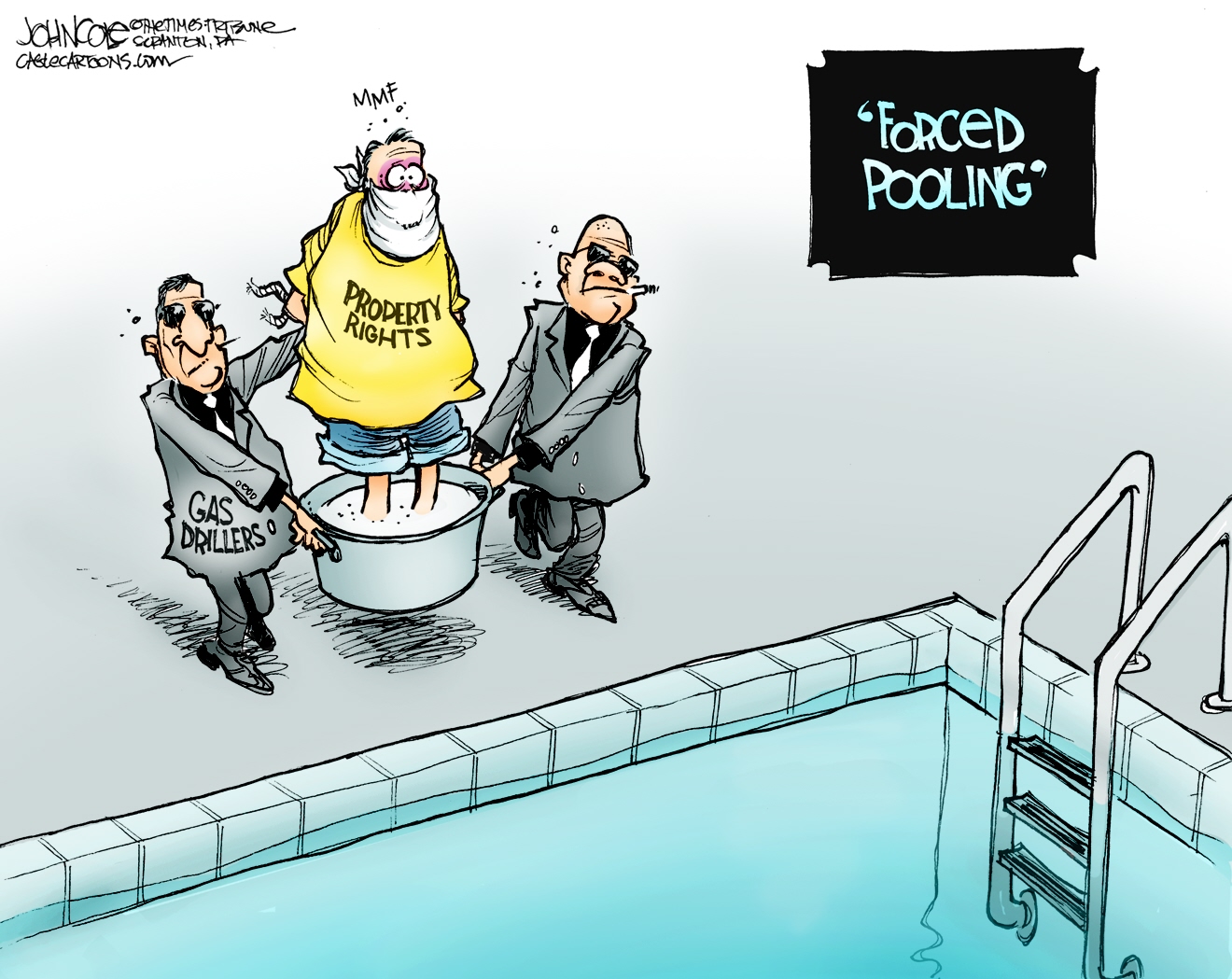
Moratorium or not, New York remains the only state in the Union that has no autonomous environmental oversight over drilling, nor does it impose any tax on the producer. Plus it has the worst compulsory integration program. And a DEC that is infiltrated by fracking collaborators hoping to hit the revolving door into frackerdom once their work is done. In other words, New York is a fracking regulatory mess. Moratorium or no moratorium.
And the Governor of the state is little more than a wobbling dial of fracking public opinion. Which is as good an argument as any to go public with your opinion.





{ 0 comments… add one now }