




An “opinion” piece by Chris Faulkner, Co-Founder, President and Chief Executive Officer (CEO) of Breitling Energy Companies has been featured in a number of newspapers across the country.
The title varies, depending on the publication, from Dispel Myths About Fracking, Debunking Fracking Misconceptions, to The Truth About Fracking. All with Faulkner’s byline, and nearly identical.
I say nearly identical, because only in Pennsylvania version is Pennsylvania mentioned in paragraph 4.
Aside from Texas, many other areas of the country - including Pennsylvania - are also benefiting from fracking.
However, this is a minor observation compared to the more obvious recitation of the standard natural gas talking points.
FAULKNER and BREITLING ENERGY COMPANIES
 If you’ve followed by work, by now, you have probably asked the same question as I have – Who the heck is Faulkner and Breitling Energy Companies? He wasn’t on my “dot” list, but he is now.
Breitling Energy Companies is the parent company for Breitling Oil & Gas and Breitling Royalties.
Breitling Oil and Gas was founded in October of 2004 on the fundamental principles of applying state-of-the-art petroleum and natural gas exploration and extraction technology to the development of onshore oil and natural gas projects. Our focus areas include Texas, Oklahoma and Louisiana. Breitling offers oil and gas investment opportunities through direct participation programs and oil and gas direct participation working interest which enable investors to participate in the potential cash flow and unique tax benefits associated with oil and gas investments.
Breitling Royalties acquires high quality portfolios of oil and gas royalties and packages these deeded interests for accredited investors. Our properties are the most effective way to generate generational wealth in today’s economic climate.
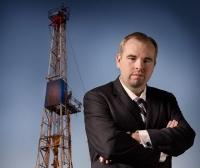 Co-founder, President and CEO of Breitling Companies is Chris Faulkner. His bio states “With diverse and extensive experience in all aspects of the oil and gas industry in North America, Europe and the Middle East, Mr. Faulkner is an advisor to the Energy China Forum (ECF) Asia Shale Committee and sits on the Board of Directors for the North Texas Commission.
Side note: ECF will be holding their 2nd Annual LNG Summit 2013 on 5/22-5/23 in Shanghai, China.
The other two co-founders are Parker Hallam: Chief Operating Officer, and Michael Miller: Chief Investment officer. Unlike, Faulkner, Hallam and Miller seem to shy away from the limelight.
Faulkner has been featured in numerous media outlets, including Reuters, Bloomberg, US News & World Report and Fox Business News as well as a frequent lecturer at industry events.
With the fall of Aubrey McClendon, (former CEO of Chesapeake Energy) Faulkner appears to the next darling spokesperson for the energy industry – but he’s not ready for prime time as his recent “opinion” article demonstrates.
FAULKNER’S OPENING PARAGRAPHS
 With multiple variations of the article’s headline, and its appearance in multiple publications, it is painfully obvious this was a press release blast. We’ll probably be seeing it reprinted in even more publications over the coming weeks, with similar variations of the headlines, thus echoing the talking points across more media venues.
For the purpose of debunking the truth about the mythical talking points, I will be referring to the version which appeared in the Philadelphia Inquirer on April 25, 2013.
Most obvious in Faulkner’s piece is the standard pre-assembled repetition of the same talking points we’ve heard time and time again from industry leaders to PR campaign spokes groups, like Energy-In-Depth (EID), to industry trade organizations and the Marcellus Shale Coalition.
YAWWWWWWWWNNNNN.
Faulkner’s first error is in using the term “FRACKING”, and spelling it with a “k”. The industry doesn’t like the word FRACKING, and prefers the longer word Hydraulic Fracturing or even unconventional drilling. As far as the spelling goes – EID bloggers are usually quick to inform people NOT to spell it with a “K”. Faulkner probably didn’t get the memo.
Before Faulkner gets into his list of points, he waves the shiny money by holding Karnes County, TX as an example.
Consider Karnes County, Texas. A few years ago, the community was plagued by poverty. Today, it’s not uncommon for local residents to collect $70 million each month in royalties for allowing energy companies to drill on their land. The wealth has increased the county’s tax base almost six-fold in two years. Last year, more than $15 billion in royalty checks was paid to private landowners by energy companies in Texas alone.
Faulkner’s picture of Karnes County is not all sunshine and rainbows where the money is concerned.
According to Karnes County Judge Barbara Shaw, while the “boom” has helped the county’s chronic financial problems, it has also created two other problems in the form of dangerous highways and destruction of roads by heavy equipment. Karnes has joined with other nearby counties in the Eagle Ford Shale play and hired a lobbyist. They are seeking legislation which would provide financial relief. Presently the state of Texas keeps the tens of millions collected from oil and gas taxes, which leave counties, like Karnes still responsible for repairing damages.
About the $15 billion in royalty checks in Texas alone? According to Ken Riley, a Kenedy City Council member, “You have a lot of people making a lot of money, but basically, it’s the people who had money to begin with - people with land, cattle, crops and government subsidies.” Homer Lott, former mayor of Runge, notes the industrialization of the area, “There used to be cattle in that pasture. Now it looks like refinery city. It won’t be long before FM 81 becomes the refinery corridor. You can’t stop change. But is there a plan in place for the transformation? Do people even realize it is happening? I don’t know if anyone has anything in place to handle it. Somebody needs to start thinking about it.”
Faulkner’s next point:
The energy and economic boom is largely the result of hydraulic fracturing - popularly known as “fracking” - a process that enables the extraction of previously intractable natural gas and oil reserves. A solution that is 99.5 percent sand and water, with a few trace chemicals, is pumped underground at high pressure to break up rock formations.
This is a good point as any to properly define “fracking”.
Hydraulic Fracturing (noun): a process in which fractures in rocks below the earth’s surface are opened and widened by injecting chemicals and liquids at high pressure: used especially to extract natural gas or oil
Faulkner’s definition is a bit slipshod. To be clear, fracking is just one small part of the entire process of drilling, extraction, refining and transport of the gas and/or oil.
Let’s do some math. Faulkner states the solution is 99.5% water and sand, this leaves .5% of what he calls “a few trace chemicals”. In the Marcellus Shale, water usage for a single “frack” ranges from 5-7 million gallons of water. Using the lower figure of 5 million gallons, there is 25,000 gallons of “trace chemicals”. Kind of eye opening when you do the math.
What are these “few trace chemicals”? We only know some of them; others are shielded by trade secrecy policies.
The majority of these chemicals do cause health problems ranging from rashes, immune disruption, and effect the brain, nervous system, reproductive organs, respiratory function, and are known carcinogens.
These include:
- (2-BE) Ethylene glycol monobutyl ether
- 2-Ethylhexanol
- Acetic acid
- Acetic anhydride
- Butanol (N-butyl alcohol, Butan-1-OL, 1-Butanol)
- Ethylene glycol
- Formaldehyde
- Glutaraldehyde
- Hydrochloric acid (HCl)
- Isopropanol (Propan-2-OL)
- Magnesium nitrate
- Methanol
- Monoethanolamine
- Petroleum distillate hydrotreated light
- Propane-1,2-diol
- Propargyl alcohol (Prop-2-YN-1-OL)
- Propylene
- Tetrahydro-3,5-dimethyl-2H-1,3,5-thiadiazine-2-thione (Dazomet)
For a list of the KNOWN chemicals used see Clean Air Council Lists Pennsylvania Fracking Chemicals. Somewhat surprising is Faulkner didn’t even mention FracFocus, probably missed that memo too.
FAULKNER’S FOLLIES: Claim #1
The list begins with Faulkner attempting to debunk fracking and water contamination.
Claim 1: Fracking will contaminate the underground water supply. Subsurface contamination from fracking is almost impossible. Fracking involves the injection of liquid 7,000 to 15,000 feet underground - far deeper than drinking water aquifers, which are often about 300 feet below the surface. Last year, an exhaustive University of Texas study done by the former head of the U.S. Geological Survey looked into alleged incidents of fracking contamination. “None of the water-well claims involve hydraulic fracturing fluid additives, and none of these constituents has been found by chemical testing of water wells,” the study concluded.
First, review the previously cited definition of “fracking”. Now read the Technical Report The Modern Practices of Hydraulic Fracturing: A Focus on Canadian Resources | The Petroleum Technology Alliance of Canada | March 2013 Journal of Canadian Petroleum Technology, specifically the part about reported incidents:

NOTE: The term “hydraulic fracturing” is often confused, purposefully or inadvertently with the entire development lifecycle. Environmental contamination can result from a multitude of activities that are part of the oil and gas exploration and production process but none have been attributed to the act of hydraulic fracturing.
In a nutshell, while fracking, that one small part of the process, doesn’t cause water contamination, there are other parts of the production process which do cause water contamination.
Another missed memo?
Faulkner goes further and cites a University of Texas (UT) study released in 2012 as further proof. He missed the memo on this one too.
Yes, the UT study did say “None of the water-well claims involve hydraulic fracturing fluid additives, and none of these constituents has been found by chemical testing of water wells”.
However, Faulkner missed the part in the study about faulty well casings, spills and leaks being attributed to water contamination, and the under-reported underground blowouts during the fracking process itself.
Mark Boling, executive vice president and general counsel of Southwestern Energy Co., a major natural-gas producer, said he has examined several incidents in Colorado and Pennsylvania where gas drilling appears to have caused gas to get into drinking water. “Every one we identified was caused by a failure of the integrity of the well, and almost always it was the cement job,” he said.
Be that as it may, Faulkner missed the memo regarding the study being withdrawn by UT after an independent review found it did not meet the scientific research standards. Chip Groat, who was head of the study, failed to disclose he is on the board of directors for Plains Exploration and Production Co, (PXP) (a gas/oil drilling corporation), and had received $413,000 in cash and stock from PXP in 2011.
FAULKNER’S FOLLIES: Claim #2
Claim 2: Fracking does lots of damage to the land surrounding a drilling rig. Drilling operations involve trucks, heavy equipment, and facilities to store waste and other by-products. However, any impact on the surface is easily remedied, and waste products are carefully disposed of. Increasingly, waste products are recycled for use in other wells or converted to deicing agents and distilled water.
Fears have also been raised about surface spills involving fracking fluids. Not only are such spills rare, but the fracking fluid involved is almost entirely water. Any harmful chemicals are used at such low concentrations that environmental damage would be negligible. John Hickenlooper, the Democratic governor of Colorado, recently told Congress he’s so confident fracking fluid is safe that he drank some of it.
Of specific interest is the “waste products are carefully disposed of” part. There have been a number of incidents where this “careful disposal of waste products” has led to arrests.
Below are three of the better known reported incidents. How many more are there that are not making headlines or found, we don’t know.
- In February of this year, an Ohio company directed employees to “carefully dispose of gas drilling wastewater” down storm drains.
- 2012: A man who worked at a Marcellus Shale gas well in Bradford County, PA, has been charged with dumping 800 gallons of hazardous materials from the drilling site. State police said 27-year-old Josh Foster of Temple, Ga., admits dumping the chemicals on state game lands in Warren Township. Troopers said Foster worked for a contractor sub-contracting to Talisman Energy at one of its drill sites near the dump location.
- On March 17, 2011 Pennsylvania Greene County resident Robert Allan Shipman and his company, Allan’s Waste Water Service Inc., were charged with illegally dumping millions of gallons of natural gas drilling wastewater across six counties in Pennsylvania from 2003-2009. The investigation of Shipman began after a client grew suspicious of illegal dumping when an in-house audit “revealed a large discrepancy in the amount of sludge received by Allan’s Waste Water and the amount of sludge disposed” by the company at treatment facilities. A review of reports by the Department of Environmental Protection confirmed that over 170,000 gallons of sludge were unaccounted for from June 2006 to the summer of 2007.
De-icing roads with flowback water. :sigh: Flowback waste fluid also contains toxic chemicals, heavy metals and radioactive materials.
Flowback waste fluid is also known as “brine”, but it is not the kind of brine your grandmother uses to pickle cucumbers.
About 15 percent of the water used to frack a well comes back up, tainted with salt and hazardous metals that can include barium, cadmium and chromium. Using the low end number of 5 million gallons of water to frack a gas well, this means approximately 750,000 gallons of frackwater is initially returned to the surface.
After the initial surge of “flow back” water, wells continue to produce brine that contains even higher concentrations of salt, metals and minerals. “Brine water” is about 5-6 times saltier than sea water.
On paved roads, the brine water will inevitably run off to the sides and into a waterway, livestock pastures and crop fields. Any radioactivity in the brine water that remains on the ”road will be resuspended by traffic into the air with the resulting direct exposure to humans or biota.”
When spread on dirt roads, the brine water is adsorbed by the dirt. As it dries out, the radioactive waste is resuspended in the dust from the road. The dust particle size and concentration is determined by the weight of a vehicle, the number of tires and its speed. The dust is inhaled by humans and animals and deposited on the local vegetation.
Just what I want, a glow in the dark car rusting out from under me. (See: Fracking – The Elephant in the Gas)
As far the remainder of Faulkner’s Follies #2 - “Fears have also been raised about surface spills involving fracking fluids. Not only are such spills rare, but the fracking fluid involved is almost entirely water. Any harmful chemicals are used at such low concentrations that environmental damage would be negligible.” - I’ve previously debunked his debunking.
FAULKNER’S FOLLIES: Claim #3
Claim 3: Fracking causes earthquakes. Last year, Congress asked the National Research Council to study the relationship between fracking and earthquakes. Every year, there are about 14,450 naturally occurring earthquakes worldwide of magnitude 4.0 or greater. According to the National Research Council, just 154 earthquakes over the past 90 years have been the result of manmade activity. Of those, only 60 were in the United States, and nearly all were moderate to small. The council concluded that fracking is extremely unlikely to cause earthquakes.
Faulkner is being a bit disingenuous with stating “fracking causes earthquakes”, but if you want to split hairs, it’s true. Fracking doesn’t cause earthquakes, but disposal of frackwaste into injection wells has been linked to a noticeable rise of earthquakes where these injection wells are located.
The connection between injection wells and earthquakes has been documented as far back as the 1960s. Rocky Mountain Arsenal (RMA) contained a deep injection well that was constructed in 1961. It was drilled to a depth of 12,045 feet (3671 m). The well was cased and sealed to a depth of 11,975 feet (3650 m), with the remaining 70 feet (21 m) left as an open hole for the injection of Basin F liquids. For testing purposes, the well was injected with approximately 568,000 US gallons (2150 m³) of city water prior to injecting any waste. The injected fluids had very little potential for reaching the surface or usable groundwater supply since the injection point had 11,900 feet (3630 m) of rock above it and was sealed at the opening. The Army discontinued use of the well in February 1966 because the fluid injection triggered a series of earthquakes in the area. The well remained unused until 1985 when the Army permanently sealed the disposal well.
See also: Earthquake Hazard Associated With Deep Well Injection - A Report to the U.S. Environmental Protection Agency (1951)
Earthquake swarms near frackwaste injection wells have been documented in Arkansas, Ohio and recently in Texas.
In March 2013, it was reported a team of federal and university geologists have linked a series of earthquakes in Oklahoma, including a 5.7 quake (which occurred near Prague OK in 2010) to injection wells. In the last four years, the number of earthquakes in the central United States spiked by 11 times compared with three decades prior, the authors of the Oklahoma study estimate.
FAULKNER’S FOLLIES: Claim #4
Claim 4: Fracking needs to be federally regulated. Since it was introduced in the 1940s, fracking has been used to extract oil and gas in America more than a million times. During that time, fracking has been regulated at the state level and has an unimpeachable safety record. A study in 2004 by the Environmental Protection Agency confirmed fracking was safe. “States are stepping up and doing a good job ,” said Lisa Jackson, President Obama’s first EPA administrator.
Even one of the nation’s largest environmental groups says federal regulation of fracking isn’t necessary. Scott Anderson, of the Environmental Defense Fund, said in 2010: “The states actually have a lot of knowledge and experience in regulating well construction and operation. We think that states have every reason to be able to tackle this issue and do it well.”
Today’s Fracking ain’t your grandpa’s fracking. The fracking used in the 1940’s was low-volume low-pressure vertical fracking.
The first experiment in fracking was in the Hugoton gas field in Grant County, Kansas by Stanolind Oil in 1949. One thousand gallons of napalm-thickened gasoline was injected, followed by a gel breaker, to frack limestone at 2,400 ft.
The fracking done today is high-volume, slick water horizontal fracking, also known as Unconventional Drilling. The technology to do unconventional drilling did not exist back in the 1940s, so to claim it’s the same thing is very misleading.
As far as regulating via the federal government or by the states, this depends on the willingness of federal or state agencies to actually enforce regulations. Going by Pennsylvania’s Department of Environmental Protection (DEP) record of enforcement, there is very little “stepping up and doing a good job” of protecting the environment. On the other hand, DEP’s record of “stepping up and doing a good job” of protecting the natural gas industry is impeccable.
About Environmental Defense Fund (EDF) – see: Environmental Defense Fund – Environment In Name Only (EINO)?
FAULKNER’S FOLLIES CONCLUSION
Just as he began his opinion piece with the “shiny”, he ends it the same way.
New energy sources are required to meet America’s needs and to reduce dependence on foreign oil. And fracking will lead to an estimated $2 trillion in U.S. capital investments through 2035. This resource boom will be a rich source of jobs. In 2011 alone, the oil and gas industry supported 9.6 million jobs.
Every community in America stands to gain from fracking, and, despite what detractors say, there’s almost no downside.
Where he found these numbers is anyone’s guess. Probably from one of the IHS Global Insight reports produced for various natural gas interests. I suggest you read IHS - Hyping the Marcellus Shale and IHS Global Insights: A Game of Clones.
I do commend his adding the qualifier to his closing sentence “…., there’s almost no downside.”
Ok, ALMOST no downside, except for what it is doing to our air, water, land, communities, and health and turning us all into “necessary sacrifices”.
©2013 by Dory Hippauf
{ 2 comments… read them below or add one }
Oh, too bad he mentioned Karnes City. I got a letter from the Eagle Ford Shale from a landowner and mineral owner in Karnes City who would do without the money to get her family’s health back.
This family was recently the subject of a news story: Fire in the Sky: The sour side of life in South Texas’ Eagle Ford Shale
“Honestly, I could give a flip about our royalties,” Myra told a Marathon worker. “We want our health back. We want our air back.”
Here’s a video of the Marathon Sugarhorn Facility spewing volatile organic compounds into the air near the family’s home.
So they named a fracking company “Breitling” - after a watch ? Why not “Fossil” ?
{ 4 trackbacks }