



 A year ago, ACT 13 was officially signed into law by Pennsylvania Governor Tom Corbett. Act 13 has been referred to as the Gift to the Gassers.
One big gift in Act 13 is the removal of zoning power by local communities. (Also known as Frack Anywhere Zoning.) By the end of March 2012, 7 towns had filed a lawsuit. The lawsuit argued, in part, that Act 13 overturns a PA Supreme Court decision in 2009 in Huntley & Huntley, Inc. v. Borough Council of the Borough of Oakmont. The Huntley v. Oakmont decision made a distinction between “where versus how” when it comes to drilling. The court said the state’s interest in oil and gas development is primarily in the efficient production and utilization of natural resources, while the county’s interest is with land use control that is consistent with local demographic and environmental concerns.
Communities which filed the lawsuit are: Cecil, Peters, Mt. Pleasant, and Robinson (Washington County); South Fayette (Allegheny County); Yardley and Nockamixon (Bucks County). A number of other communities later expressed their support for the lawsuit.
In July 2012, the Judges on the Commonwealth Court ruled that Pennsylvania cannot require municipalities to allow drilling in areas where it would conflict with their zoning rules, siding with several towns challenging the five-month-old law.
The Corbett administration quickly filed an appeal to the state Supreme Court. And there it has sat.
The PA Supreme Court has 7 judges, however one Judge, Joan Orie Melvin (R), was suspended in May 2012 following charges of “ illegally using her taxpayer-funded staff in her campaigns for a seat on the state’s highest court in a scheme that ensnared her sister, a senator awaiting sentencing on similar charges.”
The PA Supreme Court now had 6 judges – 3 Democrats and 3 Republicans. This means in the event of a “tie vote” on any case before them, the lower court’s decision stands. The appeal by the Corbett administration appeared to be a 3-3 tie. However, no final decision on the fate of the Frack Anywhere Zoning was forthcoming.
Rumors have been circulating the lower court’s decision would stand, local communities would be able to retain their zoning powers, and all would be right with the world.
 NOT SO FAST - there is a bump in the road.
On February 21, 2013 a jury found suspended Supreme Court Justice Joan Orie Melvin guilty on all but one count. Her sister, Janine Orie, was found guilty on all but one count.
Is a Melvin still a PA Supreme Court Justice? Could she resume her duties?
Melvin remains suspended without pay and the Judicial Conduct Board has disciplinary charges pending against Melvin.
Art Heinz, spokesman for the Administrative Office of Pennsylvania Courts, said the conviction doesn’t immediately change Melvin’s status, though the Court of Judicial Discipline has the authority to remove her from office if the Judicial Conduct Board charges are proven. Heinz wasn’t sure if the Supreme Court, itself, could remove Melvin from office and said Chief Justice Ronald Castille was not immediately commenting.
Pennsylvania judges may be removed in one of two ways:
The judicial conduct board investigates complaints regarding judicial conduct filed by individuals or initiated by the board. The board determines whether probable cause exists to file formal charges, and presents its case to the court of judicial discipline. The court has the authority to impose sanctions, ranging from a reprimand to removal from office, if the formal charges are sustained.
Judges may be impeached by the house of representatives and convicted by two thirds of the senate.
Only one Supreme Court Justice, Rolf Larsen, has been removed from office by impeachment. In 1994, the State House of Representatives handed down articles of impeachment consisting of seven counts of misconduct. A majority of the State Senate voted against Larsen in five of the seven counts but only one charge garnered the two-thirds majority needed to convict.
Until Court of Judicial Discipline makes a decision, the PA Supreme Court is locked at a 3-3 vote. However, if Melvin is removed, this will leave a vacancy.
Per Judicial Selection in Pennsylvania: Interim vacancies on the court are filled by gubernatorial appointment with the consent of a supermajority vote of 2/3rds of the Pennsylvania Senate. Any interim justices so appointed must stand for election at the next municipal election that is more than ten months after the vacancy occurs. However, it is a tradition that judges who are appointed as interim justices to the Supreme Court do not go on to run for permanent seats; in other words, the governor appoints judges where it is the expectation of both the governor and the judge that the judge will only fill the interim vacancy, not a permanent seat.
With the tie vote in the Supreme Court, how much pressure will be applied to officially remove Melvin to allow Corbett to appoint an Interim Judge?
Krancer Resigns
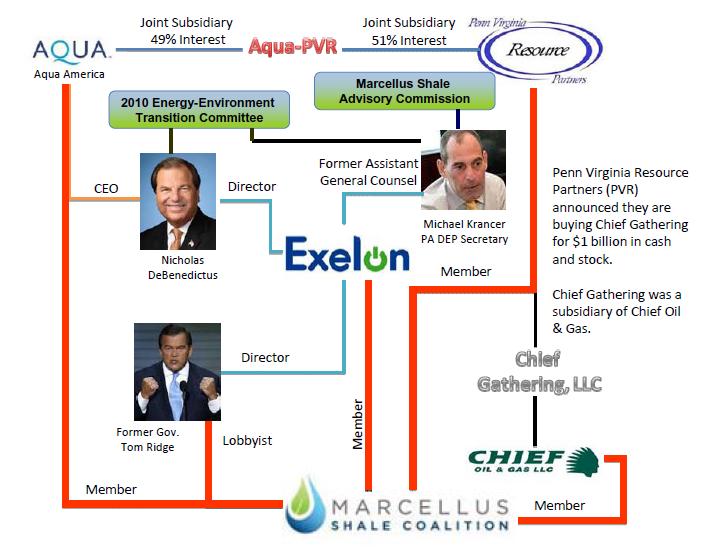
Surprise news hit Pennsylvania with the resignation of Michael Krancer, Department of Environmental Protection Secretary. Although reported in the news Krancer will be rejoining his old law firm of Blank-Rome LLP, there is speculation and concern Gov. Corbett will appoint Krancer to fill Orie’s seat when it becomes officially vacant.
Further concerns surround the fate of the 3-3 tie over the frack-anywhere zoning case, and if Krancer is appointed this will allow natural gas drilling anywhere in the state and prevent local communities from implementing zoning rules to protect their residents.
Let me point out – with Corbett able to appoint a justice, it really doesn’t matter if it is Krancer or not. Corbett won’t be appointing anyone who would oppose Corbett’s positions on anything. The PA Senate must approve the appointment by 2/3 majority.
The PA Senate currently has a Republican majority, with 27 Republicans, 23 Democratic members. (A total of 50 members). The 2/3 majority would require 33 votes. Assuming the vote falls along party lines, the Republicans would need 6 Democratic votes, or the Democrats would need 10 Republican votes.
Pressure is On
Former Governors Ed Rendell (D), Tom Ridge (R) and Richard Thornburg (R) are called for a “merit selection” process shortly after Orie was convicted.
Such a change would require state lawmakers to allow a referendum, but the Legislature has shown little inclination to change a system that some of them say already allows voters to have the ultimate decision.
“There’s a lot of people who consider that we already have merit selection, via the election process,” said Steve Miskin, a spokesman for leaders of the state House Republican majority.
The former governors made the same plea in 2010, without success, to detach judges and justices from a fundraising and campaigning process that, they say, creates a public perception of bias.
The impeachment process for Orie could begin soon.
The PA House is preparing a resolution to allow lawmakers to conduct an investigation of Orie.
Orie is scheduled for sentencing on May 7, 2013. The sentencing judge could order her to resign her post at that time. Or the court of judicial discipline could issue an order prior to the House having to take impeachment action.
Whether it is by impeachment, resignation or removal – Orie is out, it’s just a matter of when.
Krancer Appointment?
In 2007 Krancer ran and lost his bid for a seat on the PA Supreme Court, so he is not without political aspirations. However, if Corbett plans on appointing Krancer to the soon to be judicial vacancy, Krancer’s resignation as DEP Secretary at this time makes no sense. Especially when it is reported he is returning to Blank-Rome LLP. Why would Krancer resign and go back to an old job if he’s expecting to be appointed to a judicial seat? We are looking at some sort of decision on Orie’s position in a little over a month or so, it would make more sense for Krancer to stay as DEP Secretary pending an official appointment announcement.
Perhaps Krancer is not on Corbett’s list for the appointment and this prompted him to resign?
Let us assume, for a moment, that Krancer is appointed and approved. Would he be able to cast the deciding vote on the Frack-anywhere zoning case? Yes, he can make his decision based on reviewing the transcripts.
However, an argument could be made for recusal. According to CHAPTER 33. CODE OF JUDICIAL CONDUCT | Subchapter A. Canons (emphasis added)
C. Disqualification.
(1) Judges should disqualify themselves in a proceeding in which their impartiality might reasonably be questioned, including but not limited to instances where:
(a) they have a personal bias or prejudice concerning a party, or personal knowledge of disputed evidentiary facts concerning the proceeding;
(b) they served as a lawyer in the matter in controversy, or a lawyer with whom they previously practiced law served during such association as a lawyer concerning the matter, or the judge or such lawyer has been a material witness concerning it;
Official Note
A lawyer in a governmental agency does not necessarily have an association with other lawyers employed by that agency within the meaning of this subsection; judges formerly employed by a governmental agency, however, should disqualify themselves in a proceeding if their impartiality might reasonably be questioned because of such association.
(c) they know that they, individually or as a fiduciary, or their spouse or minor child residing in their household, have a substantial financial interest in the subject matter in controversy or in a party to the proceeding, or any other interest that could be substantially affected by the outcome of the proceeding;
(d) they or their spouse, or a person within the third degree of relationship to either of them, or the spouse of such a person:
(i) is a party to the proceeding, or an officer, director, or trustee of a party;
(ii) is acting as a lawyer in the proceeding;
To repeat: … judges formerly employed by a governmental agency, however, should disqualify themselves in a proceeding if their impartiality might reasonably be questioned because of such association.
Also the frack-anywhere lawsuit named as defendants Department of Environmental Protection secretary Michael Krancer, attorney general Linda Kelly, and Robert Powelson, who chairs the Public Utility Commission
Note: “…is a party to the proceeding, or an officer, director, or trustee of a party;”
This fits the bill with Krancer and frack-anywhere zoning. That being said, the operative word is “SHOULD”, it doesn’t mean a judge has to disqualify him/herself.
Where we stand with Frack-Anywhere Zoning
As I pointed out, it really doesn’t matter if Corbett appoints Krancer or someone else. Whoever it is will most likely vote according to Corbett and the natural gas corporation wishes.
The only hope we have is for the PA Senate to be unable to reach the 2/3 majority vote. That means WE the PEOPLE need to start applying our own pressure on the legislators and remind them they represent the PEOPLE and not the Natural Gas Corporations.
© 2013 by Dory Hippauf




{ 5 comments… read them below or add one }
A fine piece of research and publication Dory! The labyrinth of legalese is intentionally complex and confusing, yet you have touched on the key issues and made them transparent and nearly digestible . Krancer has an 80% DISAPPROVAL Rating in some online polls so one would think that if Corporatebutt Corbett dares to hand him yet another position of power they both will be run out of H’burg on a rail!
If appointed, and approved, and even if he recuses himself from deliberation on the Act13 ruling (which he must), having Krancer on the state’s highest court would be the worst thing that has ever happened to Pennsylvania. For many harmed by drilling, and for activists fighting to protect our environment, the judicial system is their last hope. Let’s hope he slithers back to the shadowy recesses of the private sector, and Blank Rome, and stays there.
Yet another strong analysis of the situation. It is very hard to refute anything Dory says about this Corbett Cabal. Perhaps Krancer will be appointed to the Sup. Ct.; perhaps not. But, it is obvious by his return to a law practice and a lucrative future representing the energy industry that his heart for two years as DEP secretary lay not with the people and the environment he vowed to protect but to the energy kings and their quest for corporate profits at the expense of the people. Keep up the investigations and analyses, Dory, you are more accurate than the state’s mass media.
I realize it’s small comfort, but according to former Pgh. councilman Doug Shields, whoever is named to replace Orie on the PA Supreme Court will NOT be able to weigh in on the Act 13 case, because he/she weren’t there to hear the case, [held in Pittsburgh on Oct. 17, 2012].
But we all know that more cases are coming down the [troubled] PA pike even as I type this.
Key Pennsylvania officials are hell bent on insuring every possible pro-shale gas business agenda financial break, favorable regulatory ruling and speeding up of the shale gas drilling process as possible. Yet the one thing they cannot control in thier beloved shale gas fields is the rapid rate at which these gas wells deplete.
Dory has pointed out in one of her other articles that the U.S. Department of Energy has now complied data which shows the average Pennsylvania shale gas well declines 67% in production output within 105 days of coming on line. This means shale gas costs significant and real ongoing capital investment.
Everyone can now see that the vast majority of shale gas drilling takes place in just a handful of northeastern and far southwest PA counties and precious little of it is wet oil infused gas.
The U.S. shale gas industry has spent to date $42 billion in costs to generate $32 billion in natural gas sales. Even with all the gerrymandering and political game of moving goal lines, the miserable depletion rates and lousy economics of shale gas are going to continue to force PA politicans into increasingly absurd positions to develop and promote a shale gas resource that does not last very long.
{ 1 trackback }