



 The Pennsylvania Department of Environmental Protection (DEP) responded to Observer-Reporter’s Feb. 20, 2013 editorial, “DEP owes complete disclosure to citizens”.
The Feb 20th editorial noted DEP’s absence from a hearing held by House Democratic Policy Chairman Mike Sturla, D-Lancaster announced the public hearing to look at the Pa. Department of Environmental Protection’s accountability standards regarding environmental testing following natural gas drilling.
Watch all the videos from the hearing here.
For what has previously transpired read:
- Court Documents Illuminate Pennsylvania Agency Water Test Results Suppression– Legislator Calls For State and Federal Investigation
- What’s in Your Water? Don’t ask the PA-DEP
- DEP FrackWatergate: Questions
- PA Department of Environmental Protection FrackWatergate
On Feb. 27, 2013, the Observer-Reporter published an editorial response by Katy Gresh, Communications Director for the DEP, entitled “DEP takes investigations seriously”.
Let’s go over the Gresh’s op-ed piece by piece. For conventions sake, Gresh’s op-ed is in italics; my response will be in bold.
The Observer-Reporter’s Feb. 20 editorial, “DEP owes complete disclosure to citizens” misses a few key points. This administration takes water quality investigations very seriously. In fact, it was Gov. Tom Corbett’s administration that levied a more than $1 million penalty, the largest single fine in the history of Pennsylvania’s oil and gas program, against a driller in a case involving methane migration.
An AHH-HA moment - “against a driller in a case involving methane migration“. NOTE: METHANE MIGRATION. This may be the first time DEP has PUBLICLY acknowledged METHANE MIGRATION occurs. The standard talking point line has been “fracking doesn’t cause water contamination”, which is true when the definition of “fracking” is narrowly defined and confined to the instant of explosion and fracturing of shale.
The general public tends to define “fracking” as the entire process of drilling, fracking, and extraction. This misconception by the general public has not been corrected by DEP or the Natural Gas corporations or the mass media.
The $1-million dollar fine was levied against Chesapeake energy, so this is true. However, Gresh failed to note the million dollar fine was for TWO separate incidents on opposite sides of Pennsylvania. “In Bradford County, the department said that improper well casing and cementing allowed natural gas to seep into groundwater and contaminate 16 families’ drinking water wells. The department began investigating the complaints last year.
In Avella in southwestern Pennsylvania, three condensate separator tanks caught fire on Feb. 23, injuring three subcontractors working on-site, the DEP said”
Per DEP Compliance Reports:
Parameters:Jan 1, 2011 thru Dec. 31, 2011; Unconventional Drilling Only: YES; Inspections with Violation Only: NO
2011 Penalty Amount total $3,277,250.99
Fines ranged from $190,000 to as little as $500
Specific to Chesapeake Energy, out of a total of 143 violations in 2011, penalties totaled: $1,355,102
Overall of all Drilling Corporations:
- Inspections Performed: 11,181
- Inspections With Violations: 623
- Violations: 1,151
- Enforcements: 216
- Wells Inspected: 497
Parameters: Jan 1, 2012 thru Dec. 31, 2012; Unconventional Drilling Only: YES; Inspections with Violation Only: NO
- 2012 Penalty Amount Total $84,897.84
- Fines ranged from $73,271 to as little as $500
Overall of all Drilling Corporations:
- Inspections Performed: 12,554
- Inspections With Violations: 352
- Violations: 674
- Enforcements: 231
- Wells Inspected: 302
Note: More inspections were performed in 2012 with half the amount of “violations” as in 2011. Additionally 497 wells were inspected in 2011 and 302 wells in 2012. Why? Did the drilling corporations all of a sudden decide to follow DEP regulations or is something going on with the interpretation of what is a “violation”?
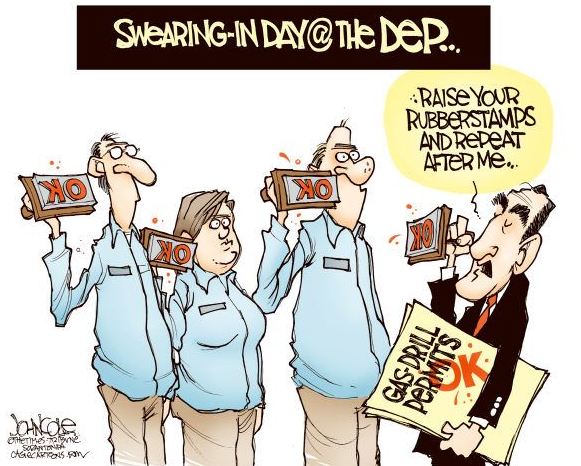
Our highly trained, expert team at DEP knows exactly what they are doing in oil and gas investigations and tests for exactly what is needed to make a determination based on sound science, not political rhetoric or scare tactics. Our Bureau of Laboratories was given high praise in a recent peer review by an independent public health association, and our oil and gas program was found to be “well-managed and professional” by another independent review body. This agency’s staff, which has responded to each and every complainant who testified at the recent policy hearing, and who responds to every complaint we receive, have decades of experience. Their integrity and work ethic cannot be questioned.
Three points here.
1. “HIGHLY TRAINED EXPERT TEAM”. Per the deposition of John Carson. DEP Water Quality Specialist. I urge you to read the WHOLE transcript.
- Page 58: Carson states he has no degrees in hydrology, geology, chemistry, or analytic chemistry
- Pages 94-95: Carson states he attended 2-3 Training sessions by Oil & Gas Industry, 1 training session by DEP, and 1 training session by DEP Bureau of Labs on sampling protocol.
I concede the point about being trained, but HIGHLY TRAINED EXPERTS? Hardly.
2. Bureau of Laboratories integrity was never an issue. Here we see some obfuscation. There is a disconnect between what the Lab tests and the report request by DEP.
Taru Upadhyay, director of the DEP’s Bureau of Laboratories, testified that although the DEP’s laboratory tests for a full range of heavy metals, the lab does not report all of the test results back to the field office, or the resident. The heavy metals left out of one particular report back to a resident of Washington County included cobalt, silicon, tin, titanium, zinc, boron, silicon, aluminum, copper, nickel, lithium, and molybdenum.
Upadhyay also testified that the DEP’s lab uses EPA approved protocols. READ HER DEPOSITION HERE.
3. This agency’s staff, which has responded to each and every complainant who testified. Again, more obfuscation. The question of DEP responding wasn’t an issue. The witnesses all stated they had contacted, and met with DEP staff regarding their complaints. The issue is NOT about QUANTITY of responses, it is about the QUALITY of those responses, and the quality is sorely lacking.
When our expert, technical staff conducts investigations, they must make decisions based on facts and data gathered and verified using approved methodologies. In these cases, DEP’s obligation is to determine if oil and gas drilling impacted water supplies, and that is exactly what we do. Data that is not important to answering that question is not validated by professional laboratory procedures, and DEP is not responsible to provide unvalidated data to a homeowner.
Again the disconnect between what the lab tests and the report requested by DEP. Report requests by DEP are submitted using “SUITE CODES”. The suite code tells the lab what to REPORT, but doesn’t tell the lab to only test for those contaminants. As stated by Upadhyay, the lab uses EPA APPROVED PROTOCOLS which means the TESTS covers more than what is requested via Suite Codes.
If the inspector is receiving an incomplete REPORT per the suite code parameters, then the inspector does not have ALL the facts and his/her decision could be erroneous.
Per DEP shelves more stringent water test | Herald-Standard | February 4, 2013 |by Rachel Morgan
The state is not using its most stringent test to review for contaminants in residential drinking water near Marcellus shale drilling.
For more than four years, the Pennsylvania Department of Environmental Protection has had the ability to test for 45 contaminants in its water-sample analysis.
But according to DEP data, the computer code that determines what substances will be tested has not been used in at least two years. It’s been shelved in favor of two codes that test for fewer than half the number of substances.
Per DEP alters policy on foul-water notifications | Pittsburgh Post-Gazette | By Don Hopey | October 14, 2012
The state Department of Environmental Protection has a new review policy for water contamination cases related to Marcellus Shale gas well operations that lets department administrators in Harrisburg instead of field offices decide whether residential water users should receive letters notifying them about problems.
That policy allows high-level DEP officials in Harrisburg to decide not to issue, or delay issuing, contamination determination letters recommended by a field office. A decision not to make that determination could save drilling companies millions of dollars in groundwater remediation, water treatment or replacement costs, and lengthen the time it takes to fix the problem.
Thanks to Act 13, we have even more tools to penalize drillers who break the law and we also have better environmental standards in place to protect groundwater. State Rep. Jesse White, D-Cecil, voted against Act 13, which, in addition to providing more than $204 million in impact fee money, of which Washington County saw more than $4 million, also provided millions more to individual municipalities. Every Pennsylvanian is benefiting from Act 13, and DEP is making sure that drilling in Pennsylvania happens safely and responsibly.
Here we go again with the shiny distraction. Ignore the problems, the impact, the damage and look at the shiny. Gresh forgot to include the “LOOK AT ALL THE JOBS, JOBS, JOBS” gas industry talking point. She also left out the part about portions of the impact fees being kicked back to the natural gas industry to construct Compressed Natural Gas (CNG) filling stations in Pennsylvania.
And please define “safely and responsibly” – these are pretty buzzwords which means little to those harmed and impacted by the industrial activities of the natural gas corporations. I have yet to see any natural gas corporation take responsibility for any damages.
©2013 by Dory Hippauf






{ 1 comment… read it below or add one }
“Our highly trained, expert team at DEP knows exactly what they are doing in oil and gas investigations and tests for exactly what is needed to make a determination based on sound science, not political rhetoric or scare tactics.”
Ripped directly from the Official Manual of Industry Talking Points.
{ 1 trackback }