


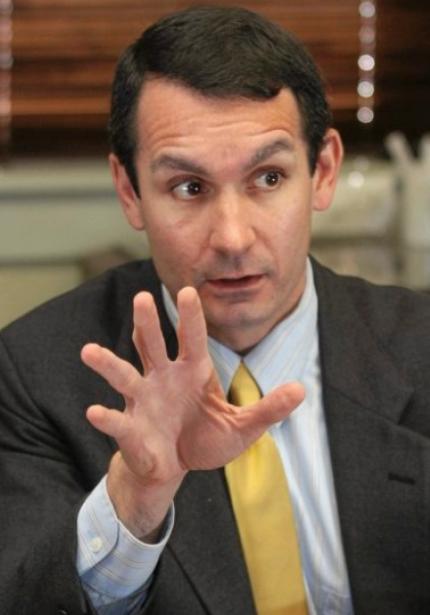
On January 15, 2013, former York County Representative Eugene DePasquale officially became Pennsylvania’s 51st Auditor General. DesPasquale’s campaign was of much interest to those involved in the issue of Natural Gas Drilling.
A short bio: From 2003 to 2006, DePasquale served as Deputy Secretary for Community Revitalization and Local Government Support of the Pennsylvania Department of Environmental Protection. In this role, DePasquale launched the Brownfield Action Team, which streamlines the process for cleaning up brownfields and claims to “lead the creation or retention of 45,000 jobs in 20 counties”
From 2007 to 2012, he served in the Pennsylvania House of Representatives, representing the York County-based 95th district.
Regarding Act 13 – DePasquale voted No.
Issue Position: Protecting the Environment
Act 13, in combination with continued reductions in the budgets of both the Department of Environmental Protection and the Department of Conservation and Natural Resources-two state agencies with primary responsibility for regulatory and enforcement activities-provides no guarantees to Pennsylvania’s communities that they will be compensated for the negative impacts of natural gas drilling or that their natural resources will be sufficiently protected. As Auditor General, Eugene DePasquale will:
Ensure DEP and DCNR maintains appropriate staffing levels to properly regulate and monitor natural gas drilling activities.
Ensure consistency among DEP regional offices in enforcement and permitting activities related to natural gas drilling activities.
Ensure DEP is monitoring water quality (including groundwater and wells) for methane and chemicals used in hydrofracking.
Ensure gas spill plans are compliant with state and federal law.
Ensure DEP is monitoring safe and appropriate disposal of waste fluids used in hydrofracking operations. Specifically, urge the DEP to mandate that drilling companies stop using treatment plans that are not equipped to remove certain contaminants from hydrofracking wastewater.
Urge amendments to Act 13 to allow health professionals to disclose information necessary to properly and appropriate treat patients or protect the public’s safety.
Ensure impact fees are adequate to compensate Pennsylvania communities for impacts caused by natural gas drilling activities. The Auditor General will scrutinize how funds are being allocated and recommend changes to Act 13, if necessary.
Urge changes to Act 13 that will extend the liability of drilling companies. Per Act 13, driller liability ends one year after a well is capped. This amount of time may be insufficient to determine if there have been public health problems or adverse effects to the environment as a result of drilling activities. Just as coal is an extremely important natural resource in Pennsylvania and has had tremendous impacts on our economy for hundreds of years, there are adverse effects throughout the state as a result of coal mining. As stated by the U.S. Geology Survey, “Drainage from thousands of abandoned coal mines has contaminated more than 3,000 miles of streams and associated ground waters in Pennsylvania and is the most extensive water-pollution problem affecting the four major river basins in Pennsylvania.”
Issue Position: Clean Energy and Green Jobs
By increasing the production of clean energy, Pennsylvania can improve its environment and create well-paying jobs. Eugene is leading the way making Pennsylvania a leader in green jobs and clean energy production.
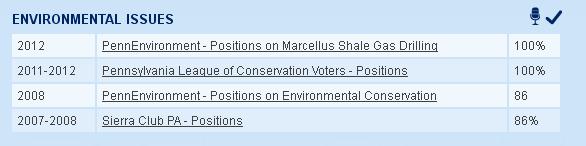
Specific to Environmental Issues, Project VoteSmart’s rating chart indicates an average of 93%:
Excerpts from January 15, 2013 remarks (Click here for full text):
“My approach to audits will be to focus on making realistic recommendations and developing workable solutions to improve government operations.”
Speaking about the growth from the natural gas drilling industry in the Marcellus Shale region, DePasquale said: “Today it is clear, we must strive to grow our economy and protect our environment at the same time. That is why, one of my first official duties as auditor general will be to initiate a performance audit of the Department of Environmental Protection to make sure our constitutional right to pure water is not being compromised by natural gas drilling.”
“As I traveled across this great state, I saw first-hand that government can, and does, make a difference in our lives when it operates as intended,” he said. “Whether it is ensuring that our water is safe to drink and our children are receiving a quality education that prepares them for the future. Or, ensuring older Pennsylvanians receive the services they need and that our state has a healthy business climate, as your Auditor General I will do everything in my power to restore your faith and confidence in government by holding agencies accountable on how they spend your tax dollars.”
Depasquale NEWS RELEASE
For Immediate Release | Contact: Barry Ciccocioppo, 717-783-1381 (cell: 717-462-0589) | Letter | Auditor General DePasquale Initiates Audit to Ensure Safe Drinking Water | Pledges that audit will be constructive and productive
Harrisburg (Jan. 16, 2013) – On his first day in office, Auditor General Eugene DePasquale notified the head of the state Department of Environmental Protection that a performance audit of water programs related to the development of the state’s shale gas reserves would begin next week.
In a letter and phone call to DEP Secretary Michael Krancer, DePasquale noted that the audit will be “a constructive one whereby all entities work together to identify any problems, concerns, and solutions, as well as any positive findings related to our audit objectives.”
DePasquale noted that the primary objectives of the audit will be to determine the effectiveness of DEP’s monitoring of water quality impacted by shale gas extraction and to measure DEP’s oversight of the handling and treatment of waste associated with the shale gas process. The audit will cover the period of 2009 through 2012.
“As I noted yesterday in my swearing-in remarks, while natural gas drilling has brought new opportunities to small towns and rural communities throughout the state, that same drilling poses challenges to our environmental regulators, our local communities and our natural resources,” the auditor general said. “However, we must strive to grow our economy and protect our environment and public health at the same time.”
The auditor general firmly emphasized that the goal of the audit of shale gas drilling and environmental protection is to ensure that Pennsylvania is doing the right thing to protect our waterways and our people while developing a valuable natural resource.
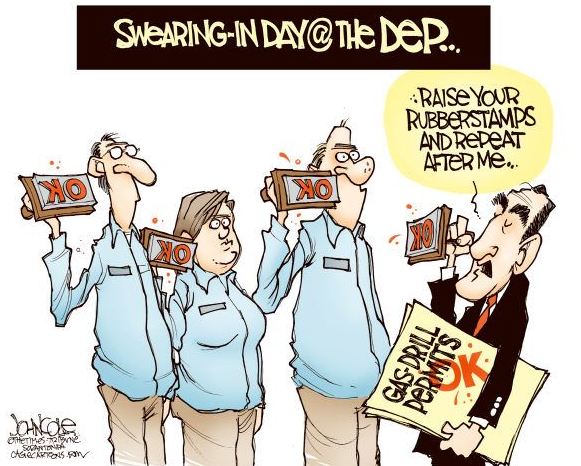
As we’ve seen over the past few years, there are serious problems not only with the natural gas corporation’s activities, but also with the Department of Environmental Protection’s (DEP) enforcement of related regulations and the almost eagerness of Governor Tom Corbett, DEP Secretary Michael Krancer, and Pennsylvania legislature to do the bidding of the natural gas industry. This has created situations which has put REAL Pennsylvanians in hazardous conditions from water contamination to air and land contamination.
With gajillions of dollars, the Marcellus Shale Coalition (MSC), the Independent Petroleum Association of America (IPAA), IPAA’s public relations project – Energy-In-Depth (EID) and others have lobbied, promoted and pushed through legislation which does not strengthen protections for Pennsylvanians, but rather weakens them to the advantage of the natural gas industry. In partnership with the natural gas industry, Pennsylvania’s government has taken a “Drill at any cost” position. Pleas for assistance from Pennsylvanian’s are ignored or brushed off as “isolated incidents”.
The Auditor Generals Job Description is defined as: The Auditor General oversees the finances of state departments and agencies. Similar to the Controller on the city level, the Auditor General conducts annual and special audits of state departments. He or she may also investigate any local government organization that collects or receives state funds.
DePasquale has stated he will investigate the DEP, but there are questions as to how effective an investigation will be in actually turning the DEP into a department which actually protects the environment as opposed to being, as some call it, the Department of Energy Production.
We can expect very loud opposition from the natural gas industry, their public relations groups, and the “drill babies” in the PA government/legislation. Will DePasquale stand firm on his findings?
Furthermore, what are the limitations to DePasquale’s powers? Is the Auditor General’s investigative scope limited to looking at what the DEP says it does and not what it should be doing? There is a big difference between minimally complying with what is written on paper and actually doing what needs to be done.
Will the investigation result in a report that goes nowhere? Will there be “teeth” in the report, or a laundry list of “recommendations”?
In addition to investigating how the DEP conducts itself with regards to the natural gas industry, DePasquale must not overlook the Pennsylvania Utility Commission (PUC), as PUC has jurisdiction over natural gas pipelines as well as the collection and dispersal of the “impact fees”. At least one of the PUC commissioners, Pam Witmer, appointed by Gov. Corbett in June 2011, has former ties to the natural gas industry.
Witmer was on Gov. Corbett’s PA Energy & Environment transition team following his election in 2010. At that time she was a Senior Associate for the Bravo Group.
Corbett Nominates Pamela Witmer To Public Utility Commission : Witmer currently the leads the energy and environment practice for Harrisburg-based Bravo Group, a governmental and public relations firm. From 2000 to 2007, she was president and CEO of the Pennsylvania Chemical Industry Council, a trade association. She formerly served as a legislative liaison for the Pennsylvania Department of Environmental Protection.
While at Bravo Group, she was a lobbyist for Chief Oil & Gas (a subsidiary of Devon Energy, Chief Gathering, LLC (a subsidiary of Chief Oil & Gas) and RRI Energy (Reliant Energy).
How many others within the natural gas industry and PA government have taken a trip on the revolving door, either going from government to jobs related to the natural gas industry or visa versa? More importantly, how much influence is being applied from the revolving doors?
As mentioned in “Range Resources Throws Poop“:
In a letter dated October 22, 2012 from Donald Gennuso, Cecil Township Manager to Jim Cannon, Local Government Affairs Manager for Range Resources, the issue of a request by Range Resources to meet with the township supervisors was addressed.
Range has offered to convince a leaseholder to drop a lawsuit filed against the town with the Pennsylvania Utility Commission if the Cecil Supervisors agree to a private meeting with Range. Dropping of the lawsuit would mean Cecil Township could receive the promised impact fees.
Range has offered to convince a leaseholder to drop a lawsuit filed against the town with the Pennsylvania Utility Commission if the Cecil Supervisors agree to a private meeting with Range. Dropping of the lawsuit would mean Cecil Township could receive the promised impact fees.
DePasquale’s audit of DEP must not end with perusing paperwork, it must also extend to connecting the dots. If this is beyond the powers of the Auditor General’s office, then perhaps the Attorney General’s office is the next stop.
© 2012 by Dory Hippauf




{ 0 comments… add one now }