


If shale was not radioactive, we wouldn’t know where to find it on a well log, since it’s identified on a gamma ray log by its radiation signature - it is the “hottest” rock in the hole. The only thing hotter would be if the driller hit a seam of uranium, which arguably the shale is, albeit in very low concentrations. The horizontal fracking of shale with water is akin to the solution mining of radioactive material - radon and radium. The frack flowback leaches the radioactivity out of the shale, and that can become too hot to handle when it is processed into a slurry - so radioactive that the disposal wells in Ohio won’t take it.
Marvin Resnikoff has done a lot of work in this area, as his article explains:
Has the USGS Been Co-opted?
Known for its objective and scientifically rigorous research, the USGS has been pulled into the battle between environmentalists and the oil and gas industry. One skirmish in the larger battle involves the radioactive gas radon in natural gas, and the potential of radon entering consumers’ homes through kitchen stoves. When stove burners are turned on, radon, a gas that does not burn, enters a home or apartment. This potential hazard has appeared in the New York City press (The Villager, “A burning issue about pipeline: Will gas pack radon?”, October 11, 2012) and energized battles against the Spectra pipeline from Jersey City into New York under the Hudson River. The pipeline would bring natural gas from the Marcellus shale formation in Pennsylvania and New York State into New York City. In response to a scientific article I authored calculating the possible radon concentrations at the wellhead (Marcellus Radon – Ethics) that has been picked up by the anti-fracking movement, the USGS sought to measure the actual radon concentrations at the wellhead. Preliminary data for two wells allegedly down to the Marcellus shale formation and other wells in Pennsylvania were published by the USGS in September 2012 (“Radon-222 Content of Natural Gas Samples from Upper and Middle Devonian Sandstone and Shale Reservoirs in Pennsylvania: Preliminary Data,” Rowan, E.L. and Kraemer, T.F., USGS Open-File Report Series 2012-1159.) The measured radon concentrations, from 1 to 79 picoCuries per liter (pCi/L), were on the low side of my calculations. Depending on the assumptions made, the paper I authored showed that the radon concentrations could range from 37 to 2576 pCi/L leading to an increased number of lung cancers. The calculations were not too much higher than radon wellhead concentrations measured by the EPA (Johnson RH, et al, EPA, “Assessment of Potential Radiological Health Effects from Radon in Natural Gas. 1973;” EPA/520/73/004) in pre-fracking days, 5 to 1450 pCi/L. The recent USGS radon measurements were also inconsistent with the concentrations of uranium and radium in Marcellus shale measured by the USGS in 1980 (Leventhal J, et al, USGS, “Geochemistry of trace elements and uranium in Devonian shales of the Appalachian Basin,” 1981; Open File Report 81-778).
Why were the USGS measurements so low and at variance with other EPA and USGS studies? Here the story takes an interesting turn. A call to one of the USGS researchers revealed the following:
In response to a request for the well logs, to examine whether the wells reached the Marcellus shale formation, the USGS researcher said they had none.
“Then, can you give us the location of the Pennsylvania wells? With the location, we could find the well logs in Pennsylvania State files.
Well, no, that would break the trust with the gas companies that allowed us access.
Okay, then how do you know you reached the Marcellus shale formation?
Because we were told so.
Who selected the wells?
The US Department of Energy in collaboration with the gas companies.
Did you feel comfortable publishing what are essentially screening results?
No, but pressure from higher-ups at USGS forced our hand .”
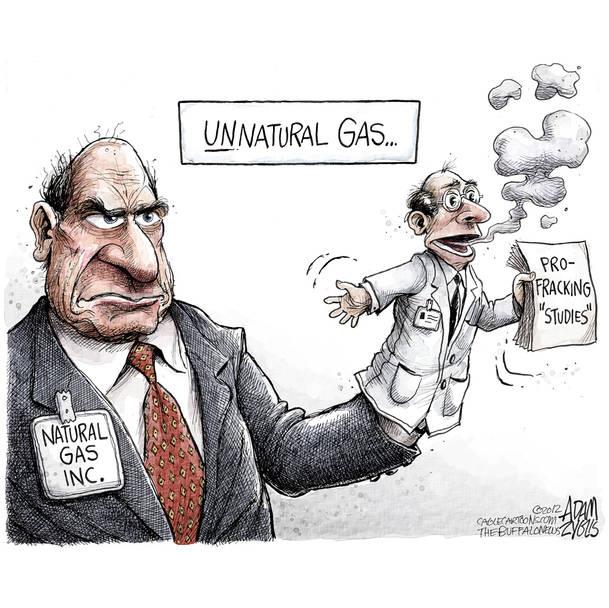
To summarize: The oil and gas industry chose specific wells, in which USGS researchers unsurprisingly measured low radon concentrations and were then pressured by the oil and gas industry to publish these preliminary findings, under the USGS imprimatur. It appears the USGS has been corrupted by the oil and gas industry.




{ 1 comment… read it below or add one }
hot fracking
{ 1 trackback }