



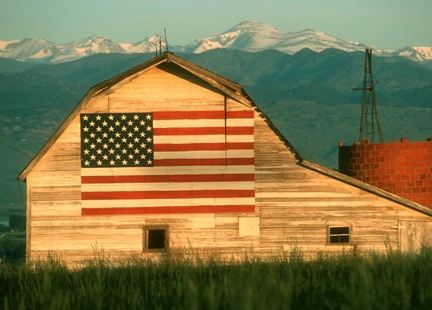
 The American Natural Gas Alliance (ANGA), an industry backed front-group, entreats the readers with “We need reliable energy to meet our growing needs. We need clean energy to protect our health and the environment. And we need domestic energy to reduce our reliance on foreign oil and bring jobs to our communities.” The ANGA page features a building with the American Flag painted across its side.
ANGA’s members include Chesapeake Energy, Devon, Encana, Cabot Oil & Gas, BG Group, BHP Billiton, Talisman Energy and Range Resources to name a few. Encana and Talisman Energy are Canadian corporations, BG Group is from theUnited Kingdomand BHP Billiton is fromAustralia.
The Marcellus Shale has been described as both the “New Texas” and as the “Saudi Arabia of Natural Gas”. Natural Gas has been promoted as the fuel that will break the oil habit and the media ads tug at our patriotic heartstrings “American Natural Gas for America”.
Terry Engelder, Professor of Geoscience at Penn State University and Co-Principal of Appalachian Fracture Systems Inc., invoked the words of John F. Kennedy during a presentation in January of 2011, “ask not what your country can do for you, ask what you can do for your country”. From there, Engelder went on to explain why people living in gas drilling fields are the sacrifice for the good of the country. Waving flags and a marching band playing Stars and Stripes forever were not part of his presentation and sorely missed.
In November of 2011, Reuters reported “Chesapeake CEO Opposes US LNG Exports”:
The head of Chesapeake Energy , one of the biggest U.S. natural gas drillers, does not want the country to ship its huge gas reserves overseas, despite agreeing to supply fuel for a proposed export project.
Record U.S. natural gas production has sparked a debate about whether the resource should be used more at home, potentially for wider use in transportation, or shipped abroad to fetch higher prices on the global market.
“I want the right to export natural gas, but I am really hopeful that we never do,” said Chesapeake chief executive Aubrey McClendon during a panel discussion on natural gas vehicles in New York on Wednesday.
America has no export facilities for natural gas. We do have import facilities, and more than one proposal to convert the import facilities to export is being reviewed by U.S. Federal Energy Regulatory Commission (FERC).
April 2012: The U.S. Federal Energy Regulatory Commission approved Cheniere Energy Inc. (LNG)’s proposal to build the nation’s largest natural-gas export terminal in Louisiana. The export terminal is expected to be operational by 2015.
So, what happened to being hopeful that we never export natural gas?
“Industry giant, “Chesapeake Energy wants to export LNG” says Mike Stice, senior vice president for natural gas projects at Oklahoma City-based Chesapeake Energy, would like to create new markets for the natural gas that is inundating the US, due in part to dramatically increased production in shale gas plays. Also, liquefying and exporting shale gas from shale plays like the Haynesville, Barnett, and Eagle Ford to global markets holds major promise as the US confronts an oversupply of cheap supplies, said analyst Rick Smead of Navigant Consulting.”
Oregon “A proposal to build a liquefied natural gas (LNG) terminal near the mouth of the Columbia River in Warrenton is reentering the regulatory running, resuscitated by burgeoning North American gas supplies after being left for dead by opponents.
Backers of the controversial Oregon LNG terminal, which would sit just across Youngs Bay from Astoria, have briefed regulators and politicians on their $6 billion plan and say they plan to file an initial application by next week with the Federal Energy Regulatory Commission.
While the proposal retains its previously planned capability to offload LNG tankers from abroad, its economic rationale is based on exporting Canadian gas through Oregon to lucrative markets in Asia.”
Louisiana: “Sempra Energy has signed development agreements with two Japanese conglomerates to help build a $6 billion liquefied natural gas export terminal at its existing import terminal in Louisiana, the San Diego based company announced Tuesday.”
From Gulf to Canada: May 2012 - Excelerate Energy, the U.S. liquefied natural gas company founded by Oklahoma billionaire George Kaiser, plans to develop the country’s first floating LNG export plant off the Gulf Coast, while Royal Dutch Shell has partnered with Asian buyers to build a plant in western Canada.
Cove Point, Maryland : April 2012 - Dominion won approval from the U.S. Department of Energy to use Cove Point for exporting up to 1 billion cubic feet of liquefied natural gas to about 20 nations with which theUnited States has free-trade agreements. The company is seeking federal permission to allow shipments to any foreign country, except those barred because of embargoes.

Selling natural gas overseas requires turning it into a liquid by cooling it to minus-260 degrees F, putting it in specially insulated Liquefied Natural Gas (LNG) ships, and then heating and re-gasifying it once it reaches its destination. The expense of re-gasification and shipping makes it easier and cheaper to sell gas in the U.S.instead, so why the sudden push to export LNG? Call it over production, low demand, or an “unusually warm winter” – there’s a glut on the market and that has driven prices to approximately $2.80/MMBtu. Much too low to drill economically, yet the Natural Gas Drillers must drill or risk losing leases on land they have already staked out. The more they drill, the bigger the glut and the lower the price. In comparison, natural gas prices are much higher in Japanand Europe.
Under U.S. law, the Energy Department cannot deny exports to 15 countries that have bilateral free trade agreements with theUnited States, a list that will soon expand when pacts with South Korea,Colombia and Panama take effect. Exports to other countries are reviewed on a case-by-case basis.
The International Players:
Natural Gas corporations stand to make larger profits by exporting. It should be no surprise to find many American Natural Gas corporations have deals with foreign corporations in Europe and Asia.
 Europe: Brigham Exploration - StatoilASA (Norway): Statoil ASA fromNorway acquired Brigham Exploration Co. for $4.4 billion in late 2011, enabling entry into the Bakken and Three Forks plays in the Williston basin inNorth Dakota andMontana. Statoil entered theUS shale gas industry in 2008 when it acquired a stake in Marcellus shale gas acreage from Chesapeake Energy and then in the Eagle Ford in a deal with SM Energy and Talisman. Statoil produces dry gas from the Marcellus, dry gas and liquids from the Eagle Ford, and now liquids from the Bakken.
Chesapeake Energy Corporation - Total E&P USA (Total SA Subsidiary): On January 25, 2010, Chesapeake entered into a joint venture with Total E&P USA, Inc., a wholly owned subsidiary of Total S.A. (Total), to develop the Company’s Barnett Shale leasehold in north-central Texas.
Chesapeake Energy Corporation - Total SA (France): France’s Total SA, long established as an international oil giant, will pay $2.25 billion for a 25 percent stake in Chesapeake’s extensive lease holdings in the Barnett Shale, the companies announced Monday.
Chesapeake Energy Corporation - StatoilHydro (Norway): joint venture transaction with StatoilHydro Chesapeake sold a 32.5% interest in its Marcellus Shale assets in Appalachia for $3.375 billion of consideration and retained a 67.5% working interest. The assets included approximately 1.8 million net acres of leasehold, of which StatoilHydro now owns approximately 0.6 million net acres and Chesapeake owns approximately 1.2 million net acres. Chesapeake received $1.25 billion in cash from StatoilHydro at closing and will receive a further $2.125 billion from 2009 to 2012 through StatoilHydro funding 75% of Chesapeake’s 67.5% share of drilling and completion expenditures until the $2.125 billion obligation has been funded. Chesapeake plans to continue acquiring leasehold in the Marcellus Shale play and StatoilHydro has the right to a 32.5% participation in any such additional leasehold.
East Resources - Royal Dutch Shell (Netherlands): The acquisition of East Resources, a Pennsylvania-based oil and gas company, on July 29, 2010, is the foundation for Shell’s new operations and growth in the Appalachian Basin. Shell’s current Marcellus Shale operations are focused in Tioga County.
Exco Resources Inc - BG Group (United Kingdom): U.K. natural gas company BG Group said Monday that it has entered a further joint venture with Exco Resources Inc. , under which it will pay $950 million for a 50% interest in companies that hold Exco’s producing and non-producing assets in the Appalachian Basin. BG Group said the deal will give it a 50% interest in a total of 654,000 net acres in the Appalachian Basin and increase its estimated gas resources by 2.4 trillion standard cubic feet.
Sandridge Energy - Repsol (Spain): SandRidge Energy Inc. entered a $1 billion deal with Spain’s Repsol, who agreed to pay SandRidge $250 million and to finance $750 million in drilling expenses over 3 years for a non-operated stake in two areas in the Mississippian requiring horizontal drilling and multistage fracturing. The venture involves a 25% non-operated working interest in the Extension Mississippian play and a 16% non-operated working interest in the Original Mississippian play.
ASIA-AUSTRALIA: Anadarko Petroleum Corp - Mitsui & Co (Japan): joint-venture agreement with Mitsui E&P USA LLC, an affiliate of Mitsui & Co., Ltd. (NSDQ:MITSY), whereby Mitsui will participate with Anadarko as a 32.5-percent partner in Anadarko’s Marcellus Shale assets, primarily located in north-central Pennsylvania, for approximately $1.4 billion. Mitsui will earn approximately 100,000 net acres in exchange for funding 100 percent of Anadarko’s share of development costs in 2010, and 90 percent of these costs thereafter, with an estimated completion of all obligations by 2013. In addition, Mitsui will have the opportunity to purchase a 32.5-percent share of Anadarko’s existing wells and additional acreage acquisitions by reimbursing a proportionate share of Anadarko’s prior expenditures, currently estimated to be approximately $100 million.
Cabot Oil & Gas - Osaka Gas Co., Ltd. (Japan): Cabot’s joint venture with Osaka transfers a 35% non-working interest in 50,000 acres of Cabot’s Pearsall Shale holdings to Osaka for $125 million in cash and $125 million in future drilling costs under a carry. The Pearsall Shale underlies the Eagle Ford Shale at depths between 7,000 and 12,000 feet, with a significantly thicker window than the Eagle Ford Shale at 600 to 900 feet
Cameron LNG - Mitsubishi Corporation (Japan): Cameron LNG, a unit of Sempra Energy , said it signed agreements with Mitsubishi Corp and Mitsui & Co to develop and construct a natural gas liquefaction export facility in Louisiana. Cameron LNG is strategically located near a major pipeline hub that serves nearly two-thirds of all U.S. natural gas markets. Cameron LNG has access to a deep ship channel close to the shoreline and is far removed from highly populated residential areas. The receipt terminal was developed to align with state and local government land-use planning efforts and is fully permitted
Carrizo Oil & Gas - Sumitomo Corp (Japan): Oil and gas explorer Carrizo Oil & Gas Inc has agreed to sell a portion of its Barnett Shale asset to a subsidiary of Sumitomo Corp for $15.7 million. As part of the deal, Japan’s Sumitomo will buy a 12.5 percent stake in 16 of Carrizo’s Barnett drilling units in Texas and help in drilling other wells at the site. Sumitomo will also have the right to participate in up to 56 future wells within these units.While announcing the joint venture in December, Sumitomo highlighted Carrizo’s holdings in the Marcellus and indicated its interest in expanding its shale presence in the U.S.
Carrizo Oil & Gas - Reliance Industries Limited (RIL) (India): Carrizo Oil & Gas announces new Marcellus joint venture with Reliance Industries and the participation in the sale of Avista Capital partners’ Pennsylvania properties Carrizo will serve as the development operator for the joint venture and Reliance has the option to act as a development operator in certain regions in the coming years as part of the joint venture.
Chesapeake Energy Corporation - CNOOC Ltd (China): CNOOC paying an initial $1.08 billion to acquire a one-third stake in Chesapeake’s Eagle Ford shale gas field, plus an additional $1.08 to fund drilling and completion costs.
Chesapeake Energy Corporation - BHP Billiton (Australia): In February 2011, Australia’s BHP Billiton Petroleum agreed to buy all of Chesapeake Energy Corp.’s interests in the Fayetteville shale in Arkansas for $4.75 billion. BHP chief executive J. Michael Yeager mentioned that the expertise gained in the Fayetteville would be useful in future developments in Australia and elsewhere.
Chesapeake Energy Corporation - China Investment Corp (China): China Investment Corp (CIC) and Singapore state investor Temasek Holdings would also take stakes in Chesapeake, although the exact investment amount was not disclosed, KIC said in a statement.
Chesapeake Energy Corporation - Hopu Investment Management Co. Ltd. (China): said it was selling a 20 percent stake in its Appalachian operations to raise $3.5 billion to pay down debt. Its first $600 million will come from Temasek Holdings, the investment company that owns and manages money for the government of Singapore, and from Hopu Investment Management Co. Ltd., a Chinese private equity firm.
Chesapeake Energy Corporation - Korea Investment Corp (South Korea): would invest $200 million in Chesapeake Energy Co as the US No.2 natural gas company was set to issue $900 million worth of convertible preferred stock.
Chesapeake Energy Corporation - Temasek Holdings (Singapore): said it was selling a 20 percent stake in its Appalachian operations to raise $3.5 billion to pay down debt. Its first $600 million will come from Temasek Holdings, the investment company that owns and manages money for the government of Singapore, and from Hopu Investment Management Co. Ltd., a Chinese private equity firm.
Chevron - Reliance Industries Limited (RTL) (India): Reliance Industries (RIL) today got a new partner for its Marcellus Shale gas assets in the US, as Atlas Energy shareholders approved its merger with Chevron Corporation. While RIL spokesperson declined to comment, a source close to the company said RIL was keen and interested in the shale gas business. Instead of working with Atlas Energy, it will now work with Chevron, he said. On January 10, Reliance Holdings USA, an arm of RIL, had written to the Atlas Energy management, questioning why RIL was not informed of the Chevron deal. RIL was miffed about being kept in dark and displeased with the fact that the valuation of Marcellus shale gas asset for Chevron deal was half of what Reliance paid for its 40 per cent stake. RIL has a 40 per cent stake in the joint venture with Atlas Energy, which it had formed last April. It had agreed to pay $1.7 billion for the said working interest in the underlying shale asset, Marcellus Shale. This included $340-million upfront cash payment and $1.36-billion drilling carry.
Devon Energy Corporation - Sinopec International Petroleum Exploration and Production Co (China): China Petrochemical Corp., the second-largest Chinese oil company, agreed to buy a one-third stake in five Devon Energy Corp. exploratory oil projects in the U.S. for $900 million to expand holdings of reserves trapped in shale. The company, known as Sinopec Group, will pay $900 million in cash and as much as $1.6 billion in Devon’s future drilling costs, funding 125 wells in the coming year, according to a statement from Devon today.
Gastar Exploration Ltd - Atinum E&P, Inc. (South Korea): $70 million Marcellus shale joint venture agreement with an affiliate of Seoul, South Korea-based investment firm Atinum Partners Co. Ltd. as part of the growing trend of international player involvement in unconventional resources in North America. Atinum Marcellus I LLC, will initially acquire a 21.43% interest in all of Gastar’s existing Marcellus Shale assets in West Virginia and Pennsylvania, approximately 34,200 net acres, and certain producing shallow conventional wells.
 Hunt Oil Co. - Marubeni Corp (Japan): Japan’s Marubeni Corp. subsidiary Marubeni Eagle Ford Ltd. agreed to buy a 35% stake in Hunt Oil Co.’s holdings in South Texas. Marubeni will pay drilling expenses for several hundred wells in future years. Marubeni and Hunt plan to jointly acquire additional Eagle Ford acreage beyond the currently held 52,000 acres.
Petrohawk Energy Corp - BHP Billiton (Australia): BHP Billiton announced an agreement in July 2011 to acquire Petrohawk Energy Corp. for $12.1 billion, giving BHP operated positions in the Eagle Ford and Haynesville shale resource plays, and also in the Permian Basin
Pioneer Natural Resources - Reliance Industries Limited (RIL) (India): Reliance Industries buys 45 percent of Pioneer Natural Resources shale gas venture for $1.3 billion Eagle Ford Shale.
Rex Energy Corporation - Sumitomo Corp (Japan): Rex Energy, an independent oil and gas company, has entered into a joint venture agreement with Summit Discovery Resources,(subsidiary of Sumitomo Corp) a trading and investment firm in Japan. Pursuant to the agreement, Rex Energy will sell and transfer interests in its Marcellus Shale assets located in Pennsylvania, including 12,900 net acres, certain producing Marcellus Shale wells and associated mid-stream assets, in a transaction valued at approximately $140.4 million. 
Samson Investment Co - Itochu Corp (Japan): Japan’s Itochu Corp. was part of an investor group led by KKR that acquired Tulsa-based Samson Investment Co. for $7.2 billion in November, 2011. Samson operates in the Bakken, Bossier, Cana Woodford, Cotton Valley, Granite Wash, Green River, Haynesville, Powder River and Green River areas. Itochu previously purchased a 25% stake in the Niobrara shale oil play in Wyoming from MDU Resources Group.
Sandridge Energy - Atinum E&P, Inc. (South Korea): Atinum Partners Co. Ltd. acquired a non-operated working interest in SandRidge’s Mississippian fields for $500 million, agreeing to a drilling carry obligation to pay 13.2% of SandRidge’s share of drilling and completion cost for wells up to $250 million during a 3-year period.
 SM Energy - Mitsui & Co (Japan): In mid-2011 a subsidiary of Mitsui & Co. Ltd. acquired a 12.5% working interest in Denver-based SM Energy Co.’s non-operated Eagle Ford shale position. Mitsui agreed to carry 90% of SM Energy’s drilling and completion costs up to a $680 million cap.
Sinopec and Chesapeake Energy
Under increasing financial pressures, Chesapeake Energy is trying to bring things under control and raise some serious cash. It recently sold CHK-Midstream to Global Infrastructure Partners (GIP) For $2.0 Billion, and will need to sell more assets quickly.
In May of 2012, Chesapeake’s largest investor, Southeast Asset Management (SAM), was reported as saying:
“We urge the board to be open to any offers to acquire the whole company,” Southeastern Asset Management Inc. Chairman and Chief Executive Officer O. Mason Hawkins wrote in a letter to Chesapeake today. While the shares have declined, “we don’t want to use this large price-to-market gap as an excuse to refuse discussions with potential acquirers who would be willing to pay a price today that recognizes the longer term value of the company.”
The Financial Times, on June 20, 2012, reported:
“Sinopec, the Chinese oil and gas group, is considering bidding for billions of dollars’ worth of assets owned by Chesapeake Energy, the U.S. gas producer.
The prize asset in Chesapeake’s disposal program for this year is its leases on 1.5 million acres (600,000 hectares) of land in the Permian Basin region of west Texas and New Mexico, one of the most coveted areas of the U.S. for oil development.
Analysts suggested last month that the land could fetch $6 billion or more, although the fall in the price of oil and the possibility of further falls to come are expected to have curbed buyers’ willingness and ability to pay higher prices. The company hopes to agree a deal by the end of September at the latest, possibly sooner”
Sinopec, if serious, is proceeding cautiously and learned the lessons from CNOOC and Unocal.
Whether its Sinopec or CNOOC or Total SA, foreign corporations have invested billions in US gas and oil drilling. These are not just joint ventures, they are also the sale of corporations and/or leases. US Natural Gas corporations and their supporters may try to downplay the foreign corporation participation, but sooner or later somebody with a question about their gas lease will make a phone call and discover their lease has been sold to “Peggy”.
UPDATE: Rice study questions volume of future US natural gas exports
HOUSTON, Aug. 15, 08/15/2012, By OGJ editors
The long-term volume of natural gas exports, if allowed by the US government, likely will not be very large given expected market developments abroad, according to a researcher from Rice University’s Baker Institute for Public Policy.
Kenneth Medlock, a Baker Institute fellow and Rice adjunct economics professor, wrote a paper entitled “US LNG Exports: Truth and Consequence” that suggests LNG exports might not boost US gas prices as much as some other observers and studies already have suggested.
———————————
Links to other articles in the Marcellus Shale Players series:
You Can’t Tell the Players Without a Scorecard!
Chesapeake Energy – Peeking Behind the Curtain
Energy-in-Depth (EID): The “GAS”roots
Aubrey McClendon: Chesapeake Energy’s Little Problem
- Chesapeake Energy Diagram
Marcellus Shale Coalition: In the Lobby
- Marcellus Shale Coalition Diagram and more info
Marcellus Shale Advisory Commission’s Swivel Chairs




{ 7 comments… read them below or add one }
Anga supports Gillibrand
http://longisland.newsday.com/templates/simpleDB/?order=employer&desc=no&pid=510¤tRecord=201
You mean Chinapeake = http://www.texassharon.com/2012/07/07/chinapeake/
yup - whenever corporations wrap themselves in the flag to promote their activities, you can bet they’re primary beneficiaries are stockholders - not stakeholders.
So sad these gas companies have to mislead the USA citizens. Worse because so many of us out there are so full of greed and believe everything they spew out and go right along with anything they say and form alliances in communities to back the gas companies. These alliances are just helping the already rich not the poor people, even within the communities.
I have sulfur water with iron in it, but since all the gas drilling by Columbia, Appalaichan and Cheasapeake it has gotten so bad in odor and taste, we can no longer use it. Our dogs won’t even drink it. We buy around 10 to 15 gallons of water a week.
When does this country wake up to the fact that these companies do not care about the USA, it cares only about padding there pockets. Sad for us and this country as the fracking sure as the devil will not help our envirnoment either. Pay attention to what is happening in this country already, as it is only going to get worse.
Just my opinion—-Paa
Appalachain also ripped all the people off on my road here as they came around after Columbia dropped all our leases then signed us all up with a tiny piece of paper promising us payment $3.oo per acre before all this stuff actually arose about fracking and bad water. The Appalachain Co. did not pay anyone else on my road but me, as I had threatened to sue them—I got my lease money for around 3 yrs. then it all stopped and a neighbor—( a big farmer tried to sue them) and did not make out at all.) Then payments stopped altogether. So after Cheasapeake took over is when we noticed all the bad water problems really. I want to know where they took all the stuff in the storage tanks that are buy each well as they get full of something and where do they get rid of it????? Did they put it back down these wells or already frack?????? We have had explosions from these wells too at a farm in the valley. So it makes me wonder how safe this all is. What does all this do to the earth in the long run. Really scares me. Hope I no longer am on this earth when it all goes haywire—it could be horrible for so many.
We need to take our blinders off and wake up here.
Just my opinion. Paa
They may have brought all your “produced water” to Texas and then pumped it down one of our over 50,000 Injection Wells which caused too many earthquakes to keep up with since June. More likely, they just took it to an injection well nearby. Glad you are concerned. Everyone should be.
http://www.texassharon.com/2012/07/28/another-fracking-earthquake-in-north-texas/
There were tons of comments on this story on FuelFix but they seem to be gone, now:
http://fuelfix.com/blog/2012/07/17/north-texas-rocked-by-11-earthquakes-in-40-days/
Thank you for this thorough research.